
Date: 2026-03-09
Let's be honest. When you're designing electronic products—whether it's a drone, a wearable device, or an automotive component—you're constantly fighting the same battle: how to make it lighter, stronger, and more reliable without breaking the bank. You've probably looked at carbon fiber before, but the rigid panels felt limiting. The materials you were using just couldn't conform to the curves and tight spaces your design demanded.
That's where flexible carbon fiber sheets come in. It's not the stiff, pre-cured panel you're used to seeing in race cars. It's something different—a material that combines the legendary strength of carbon fiber with the ability to bend, wrap, and conform to complex shapes.
Here's what you need to know.
In plain terms, a flexible carbon fiber sheet is a composite material made from carbon fibers—either woven or unidirectional—that are embedded in a partially cured or flexible resin matrix . Unlike the rigid, fully cured carbon fiber plates used in structural applications, these sheets remain pliable until they are bonded and, in some cases, fully cured.
Think of it as the "intermediate" state of carbon fiber. It gives you the strength and lightweight properties you need, but with the workability to fit into designs that simply aren't flat.
The fiber architecture varies. You'll encounter woven fabrics (plain, twill, or satin weave) that offer balanced strength in multiple directions, and unidirectional (UD) tapes where all fibers run parallel, maximizing strength in a single direction . The resin system—often epoxy, polyamide, or other thermosets—determines the final mechanical properties and heat resistance.
Not all flexible carbon fiber sheets are created equal. Here's a quick rundown of what's out there:
These are the workhorses. Made from woven carbon fiber in a flexible resin matrix, they offer excellent strength-to-weight ratios and can conform to moderate curves. They're commonly used in drone frames, automotive underbody panels, and protective enclosures .
"Prepreg" means pre-impregnated. The resin system is already infused into the fibers, but it's only partially cured (B-stage). These sheets require refrigerated storage to prevent premature curing, but they deliver superior mechanical properties, minimal voids, and excellent fiber-to-resin ratio. They're the go-to for aerospace, motorsports, and high-performance prototypes .
This is a game-changer for quick applications. A pressure-sensitive adhesive layer is applied to the back, protected by a release liner. Just peel and stick. It's ideal for retrofitting, cosmetic upgrades, and adding structural reinforcement to existing parts without complex fixturing .
For the bleeding edge of electronics, these sheets incorporate graphene or carbon nanotubes to add extraordinary electrical and thermal conductivity. They're used in flexible displays, EMI shielding, and next-generation sensors .
Sometimes you need impact resistance alongside stiffness. Hybrid sheets combine carbon fiber with aramid (Kevlar) or glass fibers to create materials that absorb energy better while retaining the lightweight character of carbon .
| Type | Flexibility | Best For | Key Limitation |
|---|---|---|---|
| Standard CFRP | Moderate | Structural parts, enclosures | Limited extreme flex |
| Prepreg | High (before cure) | Aerospace, high-performance | Requires cold storage, curing |
| Adhesive-Backed | Moderate | Retrofits, cosmetic, quick bonding | Lower temperature tolerance |
| Graphene/CNT | Very High | Electronics, sensors | Cost |
| Hybrid | High | Impact-prone areas | Slightly heavier |
If you're building electronic devices, here's why you should care about flexible carbon fiber:
Weight Reduction, No Compromise. Carbon fiber composites can be up to 20% lighter than aluminum with superior strength-to-weight ratios . In drones, that means longer flight times. In portable medical devices, that means less user fatigue. In robotics, that means faster, more efficient motion.
Electromagnetic Compatibility. Carbon fiber is electrically conductive. With the right formulation—like the graphene- or CNT-reinforced variants—it can provide excellent electromagnetic interference (EMI) shielding. Recent innovations using recycled carbon fiber nonwoven fabrics have achieved shielding effectiveness exceeding 40 dB at frequencies above 100 MHz, comparable to metal shields but at half the weight . Another study showed a flexible composite membrane maintained around 35 dB shielding effectiveness across the X-band (8.2–12.4 GHz) .
Thermal Management. Some carbon fiber composites, particularly those with graphene or CNT additives, offer exceptional thermal conductivity. They can act as heat spreaders, drawing heat away from sensitive components and improving overall system reliability.
Form Factor Freedom. Flexible carbon fiber sheets can be molded into three-dimensional shapes using vacuum bagging, autoclave curing, or compression molding . This allows you to integrate structural reinforcement directly into curved enclosures, eliminating separate brackets and supports.
Joule Heating Capabilities. Advanced formulations can even generate heat when electrically stimulated. One study demonstrated a flexible carbon composite achieving saturated temperatures up to 290°C under 5V voltage, opening possibilities for de-icing, temperature control, or self-healing applications .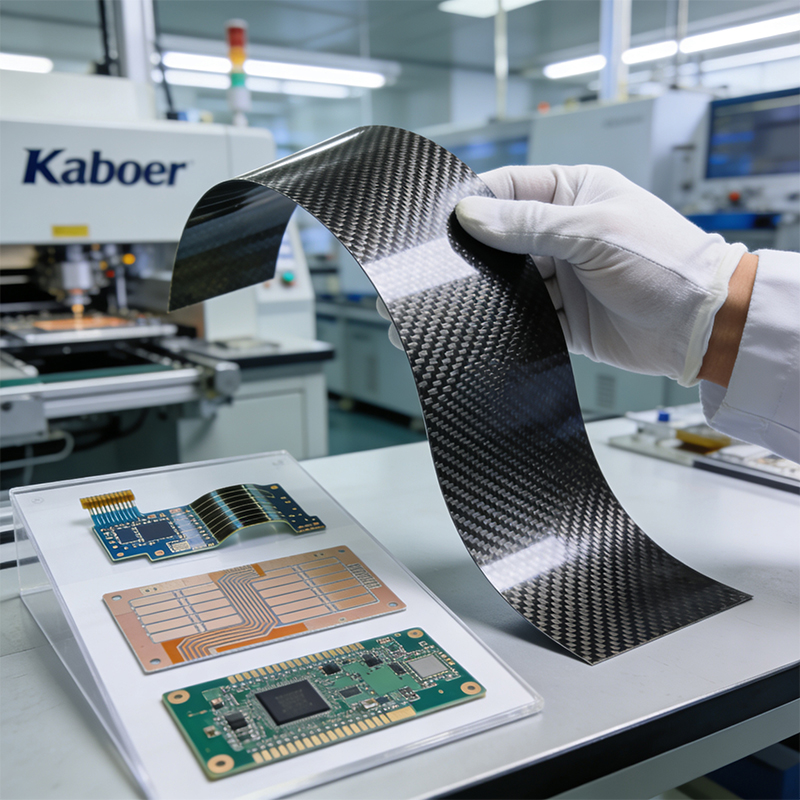
Working with flexible carbon fiber isn't without its challenges. Here's what to watch for:
Prepreg materials require refrigerated storage—typically below 18°C . If you're not set up for that, opt for standard flexible sheets or work with a partner who manages the material lifecycle for you.
Achieving full mechanical properties often requires heat and pressure. For complex shapes, you might need an autoclave, vacuum bagging setup, or heated press . Understand your process capabilities before committing to a material type.
The electrical conductivity of carbon fiber is a double-edged sword. It's great for EMI shielding, but it means you need to be careful about short circuits. Proper insulation and isolation from sensitive electronics are essential.
Flexible carbon fiber sheets can range from cost-effective (standard woven) to quite expensive (prepreg, CNT-reinforced). Balance performance needs against budget. And remember: prototyping with cheaper alternatives first can save money .
Complex, custom carbon fiber parts can have lead times stretching from weeks to months . For simple flat laminations, you might get parts in 1-2 weeks. For intricate geometries with structural analysis, plan for 2-3 months of engineering plus fabrication.
When you search for "flexible carbon fiber sheet near me," you'll quickly find that most suppliers fall into two categories: North American/European and Chinese. Both produce quality materials, but the value propositions differ :
Strengths: Strong engineering support, stable quality control, aerospace-grade certifications, autoclave precision.
Trade-offs: Higher costs (typically 2–4×), longer lead times for custom orders, higher minimum order quantities.
Strengths: Faster sample turnaround (3–7 days), more flexible customization (finish, thickness, weave, size), competitive pricing even for small batches, large-format sheet production.
Trade-offs: May not hold specific aerospace certifications (though quality for commercial applications is excellent).
For most electronic equipment manufacturers—drones, robotics, medical devices, consumer electronics—the combination of speed, flexibility, and cost from China makes compelling sense .
At Kaboer, we've been serving the electronics industry since 2009. Based in Shenzhen—the global hub for electronics manufacturing—we understand that sourcing advanced materials is only half the battle. The real win is integrating them seamlessly with your electronics.
We specialize in custom flexible PCBs, rigid-flex boards, HDI high-frequency boards, and PCBA . We own our PCBA factory, support on-site visits, and ship worldwide.
Where flexible carbon fiber sheets intersect with electronics is where things get interesting. Imagine a structural drone arm that's also an antenna. Or a wearable device housing that doubles as a heat spreader and EMI shield.
By working with a single partner who understands both the composite materials and the electronics, you eliminate finger-pointing between suppliers. We can help you:
Select the right flexible carbon fiber type for your application (standard, prepreg, adhesive-backed, conductive)
Integrate carbon fiber components with flexible PCBs and rigid-flex assemblies
Prototype quickly—fast turnaround on custom sizes and shapes
Scale from prototype to production with consistent quality
We're not just a vendor. We're a partner. We offer:
Fast prototyping – Get samples in days, not weeks
On-site factory visits – Come to Shenzhen, walk our floor, meet our team
Global shipping – Boards and assemblies delivered wherever you need them
ISO 9001, IATF 16949, ISO 14001, UL, RoHS certifications
Whether you need a standard flexible carbon fiber sheet for structural reinforcement, a prepreg material for high-performance molding, or a fully integrated solution combining carbon fiber with custom PCBs and assembly, we're here to help.
Send us your requirements—dimensions, thickness, quantity, and any special needs (conductivity, EMI shielding, adhesive backing). We'll get back to you within 2 hours with a free quote and prototyping recommendation.
Better yet—come visit us in Shenzhen. See for yourself how we turn advanced materials into real, working products.

Kaboer manufacturing PCBs since 2009. Professional technology and high-precision Printed Circuit Boards involved in Medical, IOT, UAV, Aviation, Automotive, Aerospace, Industrial Control, Artificial Intelligence, Consumer Electronics etc..


 English



 Wechat
 +86 13670210335
 +86 13670210335
 E-mail