
Date: 2026-03-09
If you've been in this industry for a while, you've probably heard the term "printed wiring board" thrown around. Maybe you use it interchangeably with "PCB." Maybe you're not entirely sure what the difference is. Either way, it's one of those terms that's been around forever—and for good reason.
Here's the thing: before we called them printed circuit boards, we called them printed wiring boards. The name stuck around, and in some circles, it's still the preferred term. But more importantly, understanding what a printed wiring board actually is helps you make better decisions when you're sourcing boards for your products.
Let's break it down in plain language.
A printed wiring board (PWB) is the traditional name for what most of us now call a PCB. It's a board that provides mechanical support and electrical connections for electronic components using conductive pathways etched from copper sheets laminated onto a non-conductive substrate .
Think of it this way: the "wiring" part of the name comes from the early days of electronics, when boards were essentially doing the job of wires—connecting point A to point B . Over time, as boards got more complex and started influencing circuit behavior (impedance control, signal integrity, etc.), the term "circuit board" became more common .
But here's the practical takeaway: whether you call it a PWB or a PCB, it's the foundation of every electronic device you've ever used. Your phone, your laptop, your car—they all run on these boards.
The printed wiring board didn't just appear out of nowhere. It evolved over decades:
1903: German inventor Albert Hanson filed a patent for "printed" wires on flat, insulated boards—the first real concept of a PWB .
1920s-1940s: Radio manufacturers started using metal strips on insulating boards to eliminate messy point-to-point wiring.
1943: Paul Eisler, an Austrian engineer, developed the first PCB that resembles what we use today . It was used in radio sets for the British military during World War II.
1950s: With the transistor revolution, PWBs became essential. The US military demanded reliable, compact electronics, and printed wiring delivered.
1960s-1980s: Multi-layer PWBs emerged, allowing more complexity in smaller spaces. Through-hole components gave way to surface-mount technology.
1990s-present: PWBs got smaller, faster, and more specialized. HDI, flex circuits, and rigid-flex designs pushed the limits of what's possible.
Today, the term "printed wiring board" is still used, especially in technical standards and by engineers who've been around long enough to remember when that's what everyone called them .
Technically, yes—but in practice, most people use them interchangeably.
A printed wiring board traditionally refers to the bare board with its conductive traces—just the wiring, no components . A printed circuit board is the broader term that includes both the wiring and the fact that the board's design deliberately affects circuit behavior .
But here's the reality: in 2026, when someone says "PWB," they almost always mean the same thing as "PCB." The only place you'll still see a distinction is in some older technical documents and in regions where "PCB" has another meaning (like in Japan, where PCB also refers to polychlorinated biphenyls—a class of toxic chemicals) .
For practical purposes, you can treat them as the same thing. The boards we build at Kaboer—whether flexible, rigid-flex, HDI, or standard rigid—are all printed wiring boards. They're also printed circuit boards. The name matters less than the quality.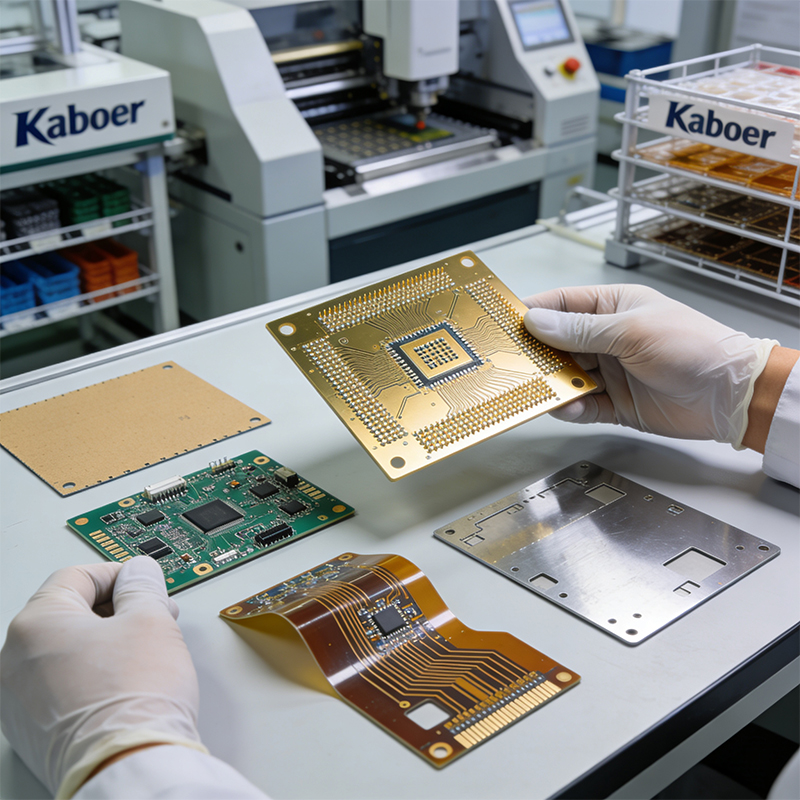
Every printed wiring board is built from a few key materials :
The Substrate: This is the board's foundation. Most PWBs use FR-4, a flame-retardant composite of fiberglass cloth and epoxy resin . It's strong, stable, and cost-effective.
For special applications, you'll see other materials:
Polyimide – For flexible circuits that need to bend
Aluminum or copper – Metal-core boards for heat dissipation
PTFE (Teflon) – Low-loss material for high-frequency applications
Ceramic – For extreme temperatures and high-power applications
Copper Foil: This becomes the traces and pads. Copper thickness is measured in ounces per square foot—1 oz (about 35 micrometers) is standard for most applications .
Solder Mask: That green (or red, blue, black, white) coating that protects the copper and prevents solder bridges .
Silkscreen: The white lettering that shows component outlines, reference designators, and test points .
Not all PWBs are the same. Here's a quick rundown of what's out there:
By layer count:
Single-sided: One copper layer. Simple, cheap. Used in calculators, power supplies, basic electronics .
Double-sided: Copper on both sides, connected by vias. Common in audio gear, industrial controls .
Multi-layer: Three to thirty-plus layers. Used in smartphones, computers, medical devices, networking gear .
By flexibility:
Rigid: Standard solid boards (FR-4). Most common.
Flexible (FPC) : Bendable polyimide substrate. Used in wearables, medical implants, foldable phones .
Rigid-Flex: Rigid and flexible sections combined. Used in camera modules, military gear, compact consumer products .
By special properties:
HDI (High-Density Interconnect) : Microvias, fine lines, high component density. Used in flagship smartphones, advanced computing .
High-Frequency: Low-loss materials (Rogers, PTFE). Used in 5G base stations, radar, RF systems .
Metal-Core: Aluminum or copper base for heat dissipation. Used in LED lighting, power electronics .
Thick-Copper: Heavy copper layers (3-20 oz) for high-current applications .
Here's something we've learned after sixteen years in this business: the quality of your printed wiring board determines the quality of your final product. You can have the best components in the world, but if the board they're sitting on is poorly made, you're going to have problems.
Reliability: A well-made PWB will last for decades. Poor-quality boards fail in months. The difference is in materials, process control, and testing .
Consistency: Good boards are identical, every time. That's essential for quality control and for trusting that your products will perform the same way, batch after batch .
Performance: For high-speed signals, controlled impedance isn't optional. Only properly designed and manufactured PWBs can deliver the performance modern electronics demand .
When you're sourcing printed wiring boards, here's what actually matters:
Can they build what you need? Layer count, minimum trace widths, special materials—do they have real experience, or just marketing claims? A manufacturer who's been doing this for years will ask questions about your design, not just say "yes" to everything .
Certifications like ISO 9001 are the baseline. What really matters is how they inspect. AOI at multiple stages? X-ray for hidden structures? Electrical test on every board? These practices separate good manufacturers from the rest .
Do they review your files before production? Do they flag potential issues and suggest improvements? This DFM feedback is free expertise—use it .
When you have questions, do you get clear answers? Is there someone who actually understands your design and can talk through technical tradeoffs? Or are you getting form responses and runaround?
Will they let you visit? A manufacturer who's proud of their facility and happy to show you around is a manufacturer with nothing to hide.
At Kaboer, we've been manufacturing printed wiring boards since 2009. Sixteen years of experience, thousands of projects, and a factory in Shenzhen equipped for the full spectrum of work.
What we make:
Flexible PWBs (FPC) : 1-20 layers, 0.075mm to 0.4mm thick
Rigid-Flex Boards: 2-30 layers, combining rigid stability with flexible interconnects
Rigid PWBs: 1-30 layers, from standard FR-4 to high-performance materials
HDI High-Density Boards: Microvias, fine lines, advanced stackups
High-Frequency Boards: Low-loss materials including Rogers and PTFE
Metal-Core Boards: For LED and power applications needing excellent heat dissipation
What sets us apart:
We own our factory. That means when you work with us, you're dealing directly with the people who build your boards—no middlemen, no miscommunication.
We do more than just make boards. Our in-house PCBA facility means you can get fully assembled, tested modules ready for integration. One partner, one quality standard, no finger-pointing between fab and assembly.
We're certified to ISO 9001, IATF 16949, ISO 14001, UL, RoHS. IPC Class 2 and Class 3 when you need the highest reliability.
And we're in Shenzhen. If you want to see how your boards are made, you're welcome to visit. Walk the floor, meet the team, ask whatever you want.
Whether you need standard rigid boards, flexible circuits, HDI designs, or full PCBA, the right partner makes all the difference.
Send us your Gerber files or requirements, and we'll get back to you with a free quote within 2 hours.
Better yet—come visit us in Shenzhen. See for yourself how we turn designs into real, working boards.

Kaboer manufacturing PCBs since 2009. Professional technology and high-precision Printed Circuit Boards involved in Medical, IOT, UAV, Aviation, Automotive, Aerospace, Industrial Control, Artificial Intelligence, Consumer Electronics etc..


 English



 Wechat
 +86 13670210335
 +86 13670210335
 E-mail