
Date: 2026-07-21
You're developing a new product. Maybe a wearable device, a medical instrument, an industrial sensor, or an IoT module. Your design is done, components are selected, Gerber files are exported. Now what?
You face a choice: wait 4-6 weeks for a standard factory lead time, or find a rapid prototyping service that can deliver finished boards in days.
Rapid prototyping PCB assembly is the accelerated design, sourcing, assembly, and testing of printed circuit board assemblies, typically in very low volumes—often between 1 and 100 units. It's not "paying extra to cut in line"—it's a service model designed specifically for speed and flexibility. Standard PCBA lead times typically run 4-8 days, while rapid prototyping can deliver samples in 24-48 hours.
In this guide, I'll explain what rapid prototyping PCB assembly is, why it's changing hardware development, and how to choose the right manufacturing partner. Plain English, no fluff.
1. First-Mover Advantage
Hardware has a brutal rule: the company that ships first captures most of the market. A month of delay means your competitors may have already locked in early customers, built brand recognition, and secured supply chain resources.
2. Faster Iteration, Lower Costs
Rapid prototyping's most direct value is shortening the "design → test → revise" iteration cycle. Engineers identify issues on Monday, revise on Tuesday, and receive updated prototypes by Wednesday. Design context isn't lost during weeks of waiting.
3. Avoid "Bet-the-Company" Production
Moving directly to production without thorough validation is extremely risky. Rapid prototyping lets you validate design feasibility for a few hundred dollars before investing tens of thousands in tooling.
The global rapid prototyping PCB assembly market was valued at $2.4 billion in 2025** and is projected to reach **$3.8 billion by 2035, growing at a CAGR of 4.8%.
The broader PCBA market is also growing fast—valued at $97.88 billion in 2025**, projected to reach **$103.37 billion in 2026 at a 6.12% CAGR. The PCB assembly market is expected to reach $108.6 billion in 2026** and expand to **$176.6 billion by 2035.
These numbers tell a clear story: rapid prototyping has shifted from "nice-to-have" to "strategic necessity." Companies that can't respond quickly are being left behind.
Rapid prototyping isn't "expedited standard PCBA"—it's a completely different service logic:
| Feature | Rapid Prototyping PCBA | Standard PCBA |
|---|---|---|
| Lead time | 24-72 hours | 4-8 weeks |
| Volume | 1-100 units | Mass production |
| Component sourcing | Stock first | Bulk procurement |
| DFM check | Within 24 hours | Days |
| Testing | Basic functional test | Full test suite |
| Cost structure | Service + materials | Volume discounts |
| Best for | Prototype validation, design iteration | Production |
Rapid prototyping's core value is speed and flexibility—not lowering per-board cost, but reducing time cost and trial-and-error cost.
A rapid prototype board typically goes through these steps:
Step 1: File Submission and DFM Check
Submit Gerber files, BOM, and pick-and-place data. Engineers complete a DFM (Design for Manufacturing) check within 24 hours. Issues are flagged with modification suggestions before production begins.
Step 2: Component Sourcing
Rapid prototyping suppliers typically pre-stock common components—resistors, capacitors, connectors, common MCUs. No waiting for parts to ship from distributors—use available inventory.
Step 3: SMT Placement and Reflow
After DFM approval, boards go directly to the quick-turn line. Dedicated prototype lines don't wait behind large production runs—your 5-board prototype doesn't queue behind a 500-panel order.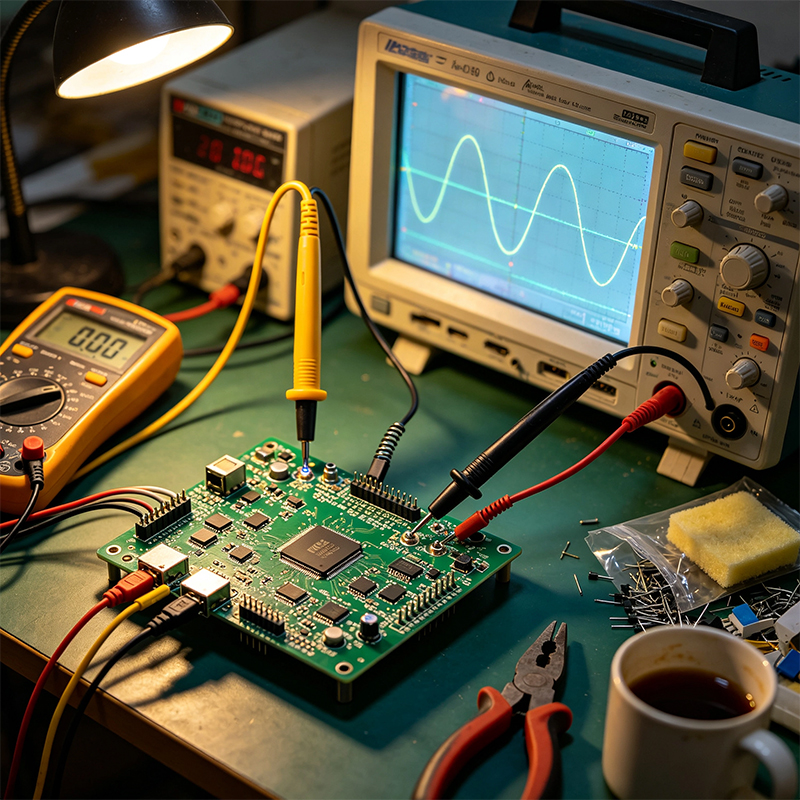
Step 4: Functional Test and Delivery
Basic functional testing confirms the board works. Then packaging and shipping—from file submission to finished boards in as little as 24-48 hours.
Rapid prototyping isn't a "silver bullet," but it's irreplaceable in these scenarios:
Prototype Validation: Quickly validate design feasibility and catch potential issues. Testing an idea for a few hundred dollars is smarter than discovering errors after investing thousands in tooling.
Design Iteration: Products requiring multiple revisions—rapid prototyping directly determines iteration speed. Waiting 4 weeks vs. 2 days per iteration can mean a 6-month difference in final product launch timing.
Emergency Replenishment: Customer suddenly adds orders that normal lead times can't meet. Rapid prototyping can fill small gaps.
Market Testing: Test market response with small quantities before full-scale investment. Validate demand before betting on volume.
Trade Show Demos: Need a working prototype in two weeks for an upcoming show. Rapid prototyping is the only option.
Many assume rapid prototyping only handles simple double-sided boards. But true rapid prototyping suppliers deliver complex boards just as fast:
Flexible PCB Rapid Prototyping: Flex boards are significantly more complex than rigid boards—polyimide substrate handling, coverlay lamination, laser cutting—each step requires specialized equipment and processes. Experienced suppliers can deliver flex prototypes in 3-5 days.
Rigid-Flex Rapid Prototyping: The rigid-to-flex transition is the biggest technical challenge in rigid-flex boards. Rapid prototyping suppliers need dedicated rigid-flex lines to deliver high-quality boards quickly.
HDI High-Frequency Rapid Prototyping: HDI boards require laser-drilled microvias, any-layer interconnects, and impedance control—high-precision processes. Rapid prototyping suppliers need specialized HDI equipment and experienced engineering teams.
We are not a standard rigid-only PCB shop. We are a one-stop manufacturer that designs and makes flexible PCBs, rigid-flex boards, HDI high-frequency boards, and then does full PCBA. Rapid prototyping is at the core of our service offering.
Rapid prototyping capability: From 4-layer to 20+ layers, from FR4 to Rogers high-frequency materials, from rigid boards to rigid-flex—we deliver prototypes in 24-72 hours.
One-stop service: PCB fabrication, SMT assembly, through-hole assembly, and testing all under one roof. Boards go straight from fabrication to the SMT line—no shipping delays between suppliers.
Flex and rigid-flex rapid prototyping: Flex and rigid-flex boards are more complex than rigid boards, but our quick-turn lines cover them too. 3-5 day delivery for rigid-flex prototypes.
HDI rapid prototyping capability: 1-order to any-layer HDI, minimum trace/space 0.05mm, minimum laser blind via 0.075mm. High-density boards can also be delivered fast.
Free DFM review: Send your design files, get a DFM report within 24 hours—including potential issues and suggested fixes. Once approved, your boards go straight into quick-turn production.
SPI + AOI + X-Ray: Solder paste inspection, post-placement inspection, post-reflow inspection, BGA inspection—quality checks at every step.
Rapid prototyping projects we've served: consumer electronics (TWS earbuds, smartwatches), automotive (sensors, BMS validation boards), medical (patient monitors, glucose meters), industrial (PLCs, motor drives).
Three simple steps:
Send your files: Gerbers, BOM, Pick & Place data, and your target lead time.
We review and quote: DFM feedback, lead time confirmation, and pricing within 2-4 hours.
Fast production: Once DFM is approved, your boards go straight to the quick-turn line—no waiting, no queuing.
Rapid prototyping PCB assembly isn't "paying extra to cut in line"—it's a service model designed for speed from the ground up.
It compresses standard 4-8 week lead times to 24-72 hours, allowing hardware developers to validate ideas, catch errors, and iterate designs in days. The global rapid prototyping market continues to grow at 4.8% CAGR, proof that more companies recognize: in hardware, speed is a competitive advantage.
If you're developing a product that needs rapid iteration, or you have an urgent project that needs fast delivery, send us your requirements. We won't make you wait weeks for DFM feedback—2-4 hour response, 24-72 hour delivery.
When you contact us, please include:
Product type and application
Target lead time (how fast do you need it?)
Estimated quantity (samples, small batch, or volume)
We'll give you an honest answer—how fast we can go, what we can't do, and how to modify your design to make it faster.

Kaboer manufacturing PCBs since 2009. Professional technology and high-precision Printed Circuit Boards involved in Medical, IOT, UAV, Aviation, Automotive, Aerospace, Industrial Control, Artificial Intelligence, Consumer Electronics etc..


 English



 Wechat
 +86 13670210335
 +86 13670210335
 E-mail