
Date: 2026-01-30
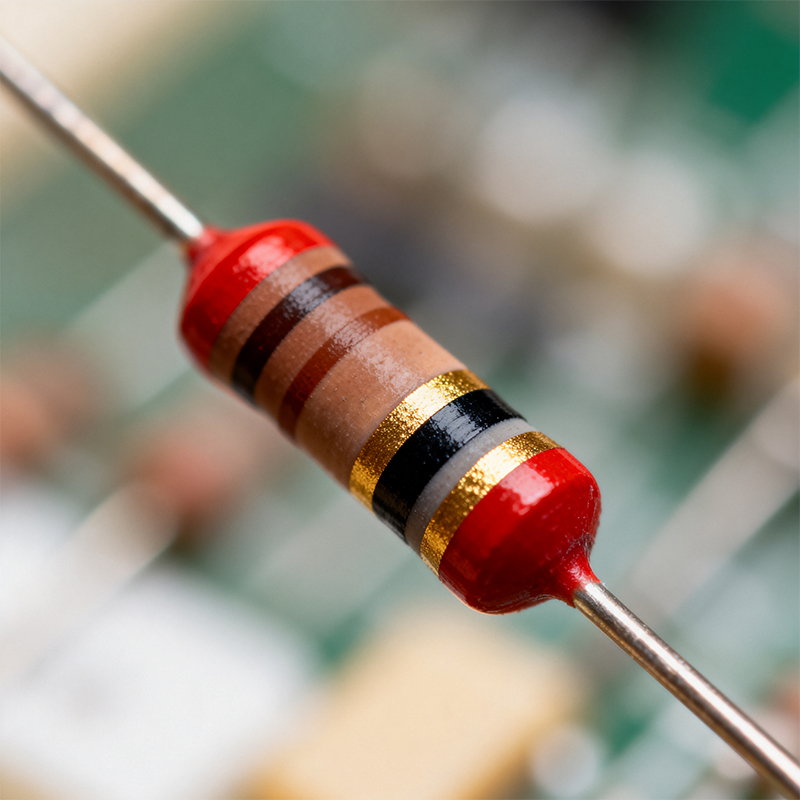
Resistors are everywhere in electronics, acting like tiny valves to precisely control the flow of electric current. But how do you know their value? They’re too small to print numbers on! Instead, they use a clever system of colored bands or tiny codes. Learning how to read a resistor is a fundamental skill, whether you’re inspecting a board, debugging a circuit, or sorting components. Let’s break it down into simple steps.
The most common type uses 4 colored bands. Here’s the foolproof method:
Find the Orientation: Hold the resistor so the gold or silver band is on the right. If there’s no metallic band, hold it so the grouped bands are on the left.
Decode from Left to Right:
Band 1: The first significant digit.
Band 2: The second significant digit.
Band 3: The Multiplier (how many zeros to add).
Band 4: The Tolerance (how much the value can vary, usually gold or silver).
| Color | Digit (Bands 1 & 2) | Multiplier (Band 3) | Tolerance (Band 4) |
|---|---|---|---|
| Black | 0 | x1 (10⁰) | - |
| Brown | 1 | x10 (10¹) | ±1% |
| Red | 2 | x100 (10²) | ±2% |
| Orange | 3 | x1,000 (10³) | - |
| Yellow | 4 | x10,000 (10⁴) | - |
| Green | 5 | x100,000 (10⁵) | ±0.5% |
| Blue | 6 | x1,000,000 (10⁶) | ±0.25% |
| Violet | 7 | x10,000,000 (10⁷) | ±0.1% |
| Gray | 8 | x100,000,000 (10⁸) | ±0.05% |
| White | 9 | x1,000,000,000 (10⁹) | - |
| Gold | - | x0.1 (10⁻¹) | ±5% |
| Silver | - | x0.01 (10⁻²) | ±10% |
Example (4-Band): Brown (1), Black (0), Red (x100), Gold (±5%) = 10 x 100 = 1,000 Ohms or 1k Ohm, with a 5% tolerance.
For More Precision (5-Band Resistors):
Some resistors have 5 bands for higher precision. The first three bands are digits, the fourth is the multiplier, and the fifth is tolerance.
Example (5-Band): Brown (1), Black (0), Black (0), Red (x100), Brown (±1%) = 100 x 100 = 10,000 Ohms or 10k Ohm, with a 1% tolerance.
Surface-Mount Device (SMD) resistors are tiny and use a printed numerical code.
3-Digit Code: The first two digits are the value, the third is the number of zeros.
"472" = 47 + 00 = 4,700 Ohms (4.7kΩ).
"100" = 10 + no zeros = 10 Ohms.
"4R7" = 4.7 Ohms (The ‘R’ acts as a decimal point).
4-Digit Code: For more precise values. The first three digits are the value, the fourth is the number of zeros.
"1502" = 150 + 00 = 15,000 Ohms (15kΩ).
EIA-96 Code (Advanced): A 2-digit number plus a letter. You need a lookup chart for this. "01A" = 100 Ohms.
Identify the Type: Is it a through-hole component with colored bands, or a tiny surface-mount chip with numbers?
Apply the Right System: Use the color chart for bands, or the digit rules for SMD codes.
State the Value Correctly: Use Ohms (Ω), kiloOhms (kΩ = 1,000Ω), or megaOhms (MΩ = 1,000,000Ω).
Why This Skill Matters:
Knowing how to read a resistor empowers you to verify circuit assemblies, replace faulty components correctly, and understand schematic diagrams in the real world. It turns a mysterious colorful speck into a clearly defined part with a critical job to do.

Kaboer manufacturing PCBs since 2009. Professional technology and high-precision Printed Circuit Boards involved in Medical, IOT, UAV, Aviation, Automotive, Aerospace, Industrial Control, Artificial Intelligence, Consumer Electronics etc..


 English



 Wechat
 +86 13670210335
 +86 13670210335
 E-mail