
Date: 2026-05-04
Let’s be real for a second: there is nothing more painful than shipping a batch of complex boards—maybe those expensive HDI high-speed circuits or intricate Rigid-Flex designs—only to have them come back a month later because of a tiny solder bridge or a flipped capacitor.
If you are an electronics manufacturer or a hardware lead, you know the stakes. You aren't just losing money; you’re losing your reputation. That is exactly where In-Circuit Test (ICT) comes into play. It’s not just a step in the process; it’s your final insurance policy.
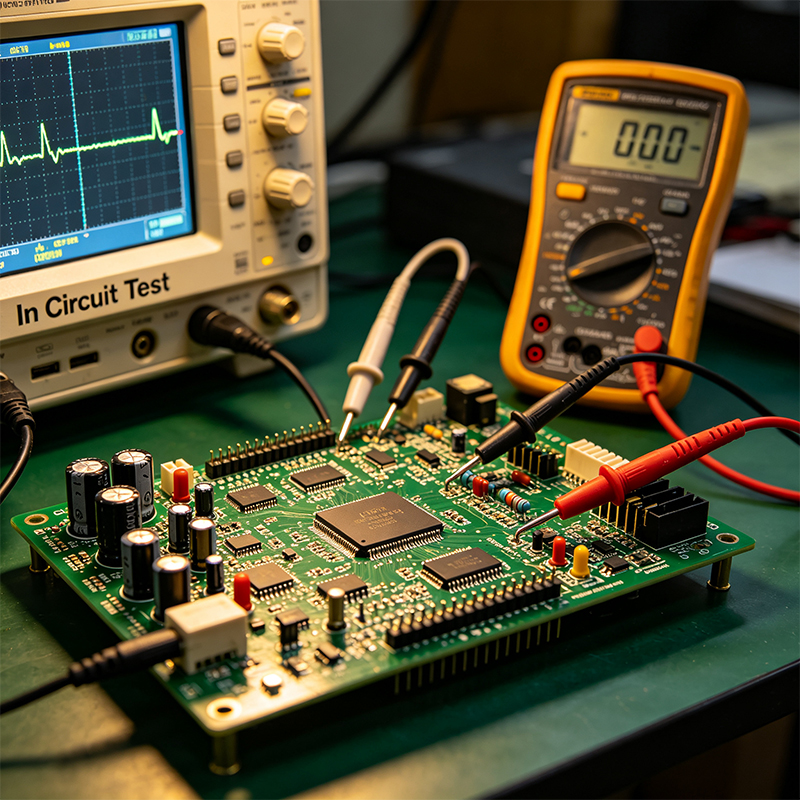
In simple terms, ICT is like a high-speed medical check-up for your circuit board. Using what we call a "Bed of Nails" (a custom fixture with hundreds of tiny pins), we probe individual components on the board.
Unlike a functional test (FCT) that just tells you if the board "turns on," ICT gets into the nitty-gritty. It checks if the 10k resistor you specified is actually 10k, or if that expensive IC was soldered correctly. It catches shorts, opens, and resistance issues in seconds.
At our facility, we handle a lot of custom Flex and Rigid-Flex PCBs. These boards are often crammed into tiny, oddly shaped enclosures (think wearables or satellite sensors).
The HDI Challenge: With high-density interconnects, the traces are so small that a human eye—even under a microscope—can miss a hairline short. ICT doesn't miss.
The Rigid-Flex Stress: Because these boards bend, solder joints can sometimes be under unique stress during assembly. ICT ensures that every connection is electrically sound before the board is ever powered up.
We get this question from our clients all the time. Here is the "no-fluff" answer:
Flying Probe: Great for prototypes. No expensive fixture needed. It's slower, but flexible.
ICT: This is the king of mass production. Yes, there’s an upfront cost for the "Bed of Nails" fixture, but the test time per board is incredibly fast. If you’re running a batch of 1,000+ boards, ICT will save you a fortune in the long run by catching defects before they hit the final assembly.
When you work with a PCBA partner, you aren't just buying a board; you’re buying a guarantee. In our lab, we don't just run the ICT and call it a day. We use the data from the Manufacturing Defect Analyzer (MDA) to tweak our SMT lines. If we see a recurring issue on a specific pad, we fix the stencil before the next hundred boards are even printed.
If you are tired of "fingers-crossed" manufacturing, it’s time to move to a partner who takes In-Circuit Testing seriously. Whether you need a 12-layer HDI board or a specialized Rigid-Flex assembly, we make sure it works before it leaves our floor.
[Got a project with tight tolerances? Send us your Gerber files and let’s talk about the best test strategy for your design.]

Kaboer manufacturing PCBs since 2009. Professional technology and high-precision Printed Circuit Boards involved in Medical, IOT, UAV, Aviation, Automotive, Aerospace, Industrial Control, Artificial Intelligence, Consumer Electronics etc..


 English



 Wechat
 +86 13670210335
 +86 13670210335
 E-mail