
Date: 2026-03-14
You've probably noticed that LED lighting has taken over—streetlights, car headlights, even the bulb in your desk lamp. They're brighter, last longer, and use less power. But behind every reliable LED light is something that doesn't get enough attention: the circuit board it's mounted on.
Here's the thing. LEDs and regular electronics have very different needs. A standard PCB might work fine for a microcontroller or a power supply, but stick an LED on it—especially a high-power one—and you'll run into problems fast. Heat builds up, brightness drops, and before long, you're dealing with dead LEDs and unhappy customers.
So what actually makes an LED light PCB board different? Let's break it down in plain English.
To understand why LED PCBs are special, you need to know how LEDs work. An LED is a semiconductor device that emits light when current passes through it . But here's the catch: only about 15-25% of the electrical energy actually turns into light. The rest? It becomes heat .
That's a lot of heat coming from a tiny chip—often just 1-2 millimeters across. The heat density is actually worse than most computer processors . And if that heat doesn't get pulled away fast, the LED gets hot. Really hot. And when LEDs get hot:
They get dimmer
The color shifts (especially reds)
They burn out way faster
Regular FR-4 circuit boards have a thermal conductivity of only about 0.3 W/m·K . That's basically like wrapping your LED in a blanket. The heat has nowhere to go.
This is where Metal Core PCBs (MCPCBs) come in. Instead of plain fiberglass, these boards have a layer of aluminum or copper built right into them . Think of it as giving your LED a metal heat sink that's part of the board itself.
A typical MCPCB has three layers:
Copper circuit layer – This is where your LED gets soldered, just like a normal board
Dielectric layer – A thin thermally conductive (but electrically insulating) layer
Metal base – Usually aluminum, sometimes copper for extreme cases
The heat from your LED flows down through the dielectric and spreads into the metal base, which acts like a giant heat sink . It's simple, it works, and it's why almost every high-power LED light uses this construction.
Aluminum is the most common choice—good thermal conductivity (1-8 W/m·K depending on the dielectric), reasonably priced . Copper-based boards are better (up to 398 W/m·K) but cost more .
Metal core isn't the only option. Depending on what you're building, you might choose something different.
FR-4 still works for low-power LEDs—think indicator lights, simple displays, anything that doesn't generate much heat . It's cheap, lightweight, and good electrically. Just don't push too much power through it.
Ceramic PCBs are the premium choice. They handle heat even better than metal core (thermal conductivity from 20 to over 200 W/m·K), and they're electrically insulating . Great for high-intensity industrial or automotive lighting where reliability matters. The downside? They're more expensive and can be brittle.
Flexible LED PCBs use polyimide film instead of rigid material . These are what you see in LED strips, decorative lighting, or anywhere the board needs to bend. You can roll them up, wrap them around corners, tuck them into tight spaces.
Once you have the right board, you need to put LEDs on it. Two main ways to do that.
This is the standard method for most electronics. The LEDs come as tiny surface-mount components, and a pick-and-place machine puts them on the board . Then the whole thing goes through a reflow oven to melt the solder.
SMT is flexible, fast, and works well for designs with multiple LEDs spread across the board.
COB is different. Instead of packaging each LED separately, the bare LED chips get mounted directly onto the PCB . Gold or aluminum wires connect them to the circuit.
Why do this? Because you eliminate layers of packaging between the LED and the board. Heat flows straight into the PCB, which means better thermal performance . COB also gives you more uniform light and can pack LEDs much denser .
Flip-chip COB takes it even further—the LED flips upside down so the light-emitting side faces up and the electrical contacts connect directly . No wires needed. It's getting popular for high-end applications.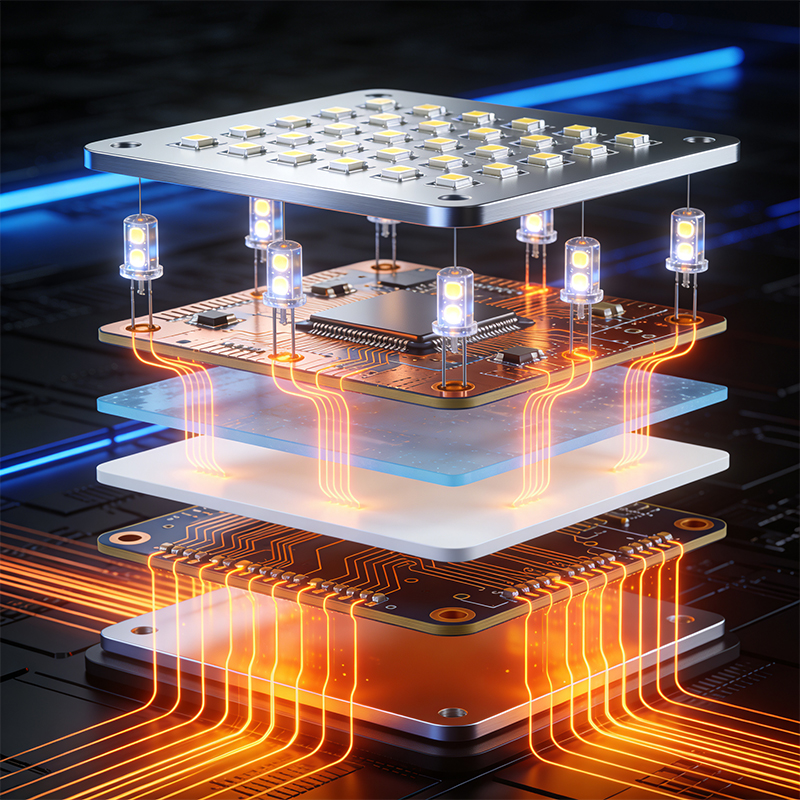
If you're designing an LED board yourself, here are the things that make or break the design.
Everything else comes second. Use thermal vias—little holes filled or plated with copper—to pull heat down from the LED pads into inner layers . Put them in dense arrays, spaced about 0.5-1.0 mm apart, right under where the LEDs sit .
Make sure thermal pads on components line up with the board's heat dissipation areas. Don't let them float out over empty space .
For parallel LED strings, this matters especially. If one branch has longer traces than another, it gets different current. Different current means different brightness. And different brightness means your nice uniform light now has stripes .
Keep supply and return traces paired up, running close together. That cancels out magnetic fields and reduces inductance .
For mixed series-parallel layouts, use wide copper pours as "power buses" and connect each branch symmetrically .
Put driver ICs as close to the LEDs as possible. Shorter traces mean less resistance, less voltage drop, less power wasted .
For LEDs themselves, decide whether to cluster them or spread them out. Clustering makes thermal management simpler—all the heat in one place—but creates hotspots. Spreading gives more uniform temperature across the board but raises the overall baseline . No single right answer; depends on your cooling strategy.
Don't just build it and hope. Do the math first. Junction temperature Tj equals ambient temperature Ta plus power dissipated Pd times thermal resistance Rθ .
If that number comes out higher than your LED's maximum rating, you need better cooling—bigger heat sink, better board material, more copper.
Simulations help. Even simple thermal modeling during design catches problems before you spend money on prototypes .
And when you do get prototypes, test them. Thermocouples, IR cameras, forward voltage measurements—all tell you whether your thermal design actually works .
At Kaboer, we've been building PCBs since 2009, and we've made plenty of LED boards—for streetlights, automotive lighting, commercial fixtures, you name it.
We understand that LED PCBs aren't ordinary boards. They need the right materials, the right layout, the right assembly. That's why we offer:
Aluminum and copper-based MCPCBs with thermal conductivity matched to your power levels
Ceramic PCBs for extreme applications where nothing else works
Flexible LED PCBs when you need bendable solutions
FR-4 boards for simpler, low-power designs
SMT and COB assembly in our own PCBA factory
Fast prototyping to validate your thermal design before committing to volume
We're based in Shenzhen, and we welcome customers to visit our factory—see how your boards get made, meet the people building them, ask whatever questions you have.
LED lighting isn't going away. It's getting brighter, more efficient, more everywhere. But none of that matters if the boards underneath can't handle the heat.
If you need LED PCBs that actually work—boards designed with thermal management in mind, built with the right materials, assembled by people who understand what they're doing—let's talk.
Send us your requirements. We'll help you choose the right board type, give you a free quote within 2 hours, and get you prototypes fast.
And if you're ever in Shenzhen, come visit. See for yourself what goes into boards that keep their cool.

Kaboer manufacturing PCBs since 2009. Professional technology and high-precision Printed Circuit Boards involved in Medical, IOT, UAV, Aviation, Automotive, Aerospace, Industrial Control, Artificial Intelligence, Consumer Electronics etc..


 English



 Wechat
 +86 13670210335
 +86 13670210335
 E-mail