
Date: 2026-03-04
You've got a great design. Maybe it's for a specialized medical device, a prototype you're about to test, or a product that only needs a few hundred units a year. The question is: how do you get it assembled without committing to thousands of boards you don't need?
That's where low volume circuit board assembly comes in. It's the perfect solution for companies that need quality, reliability, and professional assembly—just not in massive quantities.
This guide covers everything you need to know about low volume assembly, why it makes sense for certain projects, and how to find a partner who treats your small batch with the same care as a million-unit order.
Low volume assembly simply means having your circuit boards populated with components in quantities that are smaller than typical mass production runs. There's no strict definition, but it usually means anywhere from a handful of prototypes up to a few thousand boards .
This approach is ideal for:
Prototypes and engineering validation – Testing your design before committing to mass production
Pilot runs – Proving out your manufacturing process with a small batch
Specialized or niche products – Medical devices, industrial controls, aerospace applications where volumes are naturally lower
Startups and small businesses – Companies that haven't yet scaled to high-volume production
Legacy product support – Keeping older products alive without massive minimum orders
The key difference from high-volume assembly isn't the process itself—it's the flexibility, the attention to detail, and the willingness to work with smaller quantities .
Ordering thousands of boards when you only need a few hundred ties up capital and creates storage problems. Components become obsolete. Designs change. Low volume assembly lets you order what you actually need, when you need it .
Product development is rarely a straight line. You test, you learn, you improve. With low volume runs, you can refine your design based on real-world feedback without being stuck with a warehouse full of boards you can't use .
Just because your quantity is small doesn't mean you should settle for hand-soldering. Professional SMT assembly gives you reliable, consistent boards—even in small batches. Automated placement, reflow soldering, and proper inspection make a huge difference in quality .
Not every product needs to sell a million units. If your market is specialized—medical, industrial, aerospace—low volume assembly is the economical way to serve it .
The actual assembly process for low volume runs is nearly identical to high-volume production, just scaled appropriately:
Solder paste is applied to the board's pads using a stencil. For low volumes, this might be a laser-cut stencil just like high-volume runs—the same precision, just fewer boards .
Components are placed by automated pick-and-place machines. Even in small batches, the accuracy is the same: components positioned within fractions of a millimeter .
Boards go through a reflow oven with carefully controlled temperature profiles. The thermal curve is optimized for your specific board, ensuring proper melting and solidification of the solder .
Every board should be inspected, regardless of quantity. This includes:
AOI (Automated Optical Inspection) for visible defects
X-ray inspection for hidden joints like BGAs and QFNs
Functional testing to verify the board works as designed
In low volume runs, minor issues can sometimes be corrected by skilled technicians—something that's impractical in high-volume production .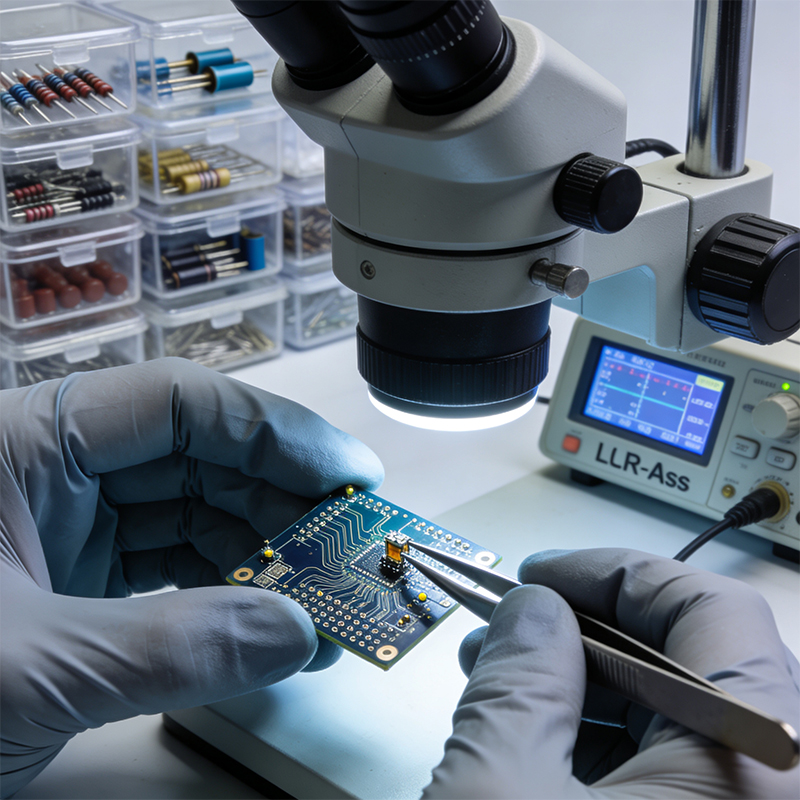
Low volume doesn't mean low quality. The same standards apply:
IPC-A-610 Class 2 or 3 – The industry standard for electronic assembly quality
J-STD-001 – Requirements for soldered electrical connections
ISO certifications – For medical, automotive, and aerospace applications
A good low volume assembler follows these standards just as rigorously as a high-volume factory. The only difference is the quantity .
Technical capability – Can they handle your components? Fine-pitch ICs? BGAs? Mixed technology (SMT + through-hole)? Their equipment should match your needs.
Flexibility – Are they willing to work with your quantities? Do they offer engineering support for design improvements?
Quality processes – Do they have AOI? X-ray? Functional testing? The same inspection standards should apply regardless of volume.
Communication – Small runs often need more back-and-forth. A responsive, clear communicator saves headaches.
Component sourcing – Can they source parts for you? Low volume sourcing is tricky—suppliers don't always want to sell small quantities. A partner with good supply chain relationships helps.
They treat your small order as an inconvenience
No engineering review before production
Unwilling to share inspection data
Unclear about their capabilities or limitations
At Kaboer, we've been helping companies with their circuit board needs since 2009. Based in Shenzhen, China, we understand that not every project needs a million boards. Sometimes you need ten, or fifty, or five hundred—and you need them done right.
We treat every order, regardless of size, with the same care and attention. Whether you're a startup building your first prototype or an established company supporting a niche product line, you get:
Professional SMT assembly using the same advanced equipment as our high-volume lines
Full inspection including AOI, X-ray, and functional testing
Engineering support to review your design and catch issues before assembly
Component sourcing assistance for those hard-to-find small quantities
We integrate low volume assembly with our own circuit board fabrication, giving you a seamless experience:
Flexible PCBs (FPC) : 1-20 layers, 0.075mm to 0.4mm thick – Perfect for wearables, medical devices, and compact designs
Rigid-Flex Boards: 2-30 layers – Rigid where you need stability, flexible where you need movement
Rigid PCBs: 1-30 layers – From standard FR-4 to high-performance materials
HDI High-Density Boards: Microvias, fine lines, advanced stackups – Supporting the latest BGA and high-speed designs
High-Frequency Boards: Low-loss materials including Rogers and PTFE – For 5G, radar, and RF applications
Metal-Core Boards: Aluminum or copper base – For LED lighting and power applications requiring excellent heat dissipation
We're certified to international standards:
ISO 9001:2015 – Quality Management
IATF 16949:2016 – Automotive
ISO 14001:2015 – Environmental Management
UL and RoHS compliance
Our assembled boards meet IPC Class 2 and Class 3 requirements for applications that demand the highest reliability .
We understand that small runs need more flexibility. That's why we offer:
Low minimum order quantities – Even single prototypes are welcome
Engineering support – We review your design and suggest improvements
Fast turnaround – Get your boards when you need them, not months later
One-stop service – Fabrication and assembly in one place, no finger-pointing
We believe the best partnerships are built on trust. That's why we welcome our global clients to visit our factory in Shenzhen. Walk our production floors. Meet our engineering team. See firsthand how your boards are assembled—whether you're ordering ten or ten thousand .
Low volume circuit board assembly is the smart choice for prototypes, niche products, and companies that value flexibility over mass production. The key is finding a partner who treats your project with the attention it deserves.
Contact Kaboer today to discuss your low volume assembly needs. Better yet—come visit us in Shenzhen and see for yourself how we bring small-batch projects to life with the same precision and care as the big runs.

Kaboer manufacturing PCBs since 2009. Professional technology and high-precision Printed Circuit Boards involved in Medical, IOT, UAV, Aviation, Automotive, Aerospace, Industrial Control, Artificial Intelligence, Consumer Electronics etc..


 English



 Wechat
 +86 13670210335
 +86 13670210335
 E-mail