
Date: 2026-03-06
You know that feeling when you open a new gadget and marvel at how tiny and packed it is? A smartphone thinner than a pencil, yet more powerful than a room-sized computer from decades ago. That's not magic. That's SMT technology.
SMT stands for Surface Mount Technology. It's the method used to mount electronic components directly onto the surface of a printed circuit board. And honestly, without it, the electronics world as we know it wouldn't exist.
This guide breaks down what SMT technology actually is, why it matters for your products, and how to make sure you're getting quality assembly—not just cheap quotes.
Here's the simple version: instead of pushing component leads through holes in a board (that's old-school through-hole technology), SMT places components directly on the board's surface . The components—called Surface Mount Devices, or SMDs—have tiny metal terminations that get soldered right onto copper pads.
Think of it like this:
Through-hole is like nailing something through a board
SMT is like sticking magnets on a metal surface
The result? Components can be incredibly small, both sides of the board can be used, and the whole process runs on high-speed automated machines .
SMT didn't become the standard by accident. It offers some serious advantages:
SMT components are tiny—we're talking 0402 (1.0mm × 0.5mm) or even 0201 (0.6mm × 0.3mm) packages . That means you can pack way more functionality into the same board space. A smartphone would be the size of a tablet if it still used through-hole parts.
Those short connections matter. Through-hole leads create parasitic inductance (about 10-15 nH) that messes up high-frequency signals. SMT joints are under 1 nH, making them essential for anything running at GHz speeds—5G, DDR memory, you name it .
Pick-and-place machines can place tens of thousands of components per hour with ±25 μm accuracy . That's not just fast—it's consistent. Every board comes out the same, which is impossible with hand assembly.
Yes, the equipment investment is significant. But once you're running, the per-board cost drops dramatically. No drilling holes, less material waste, faster production .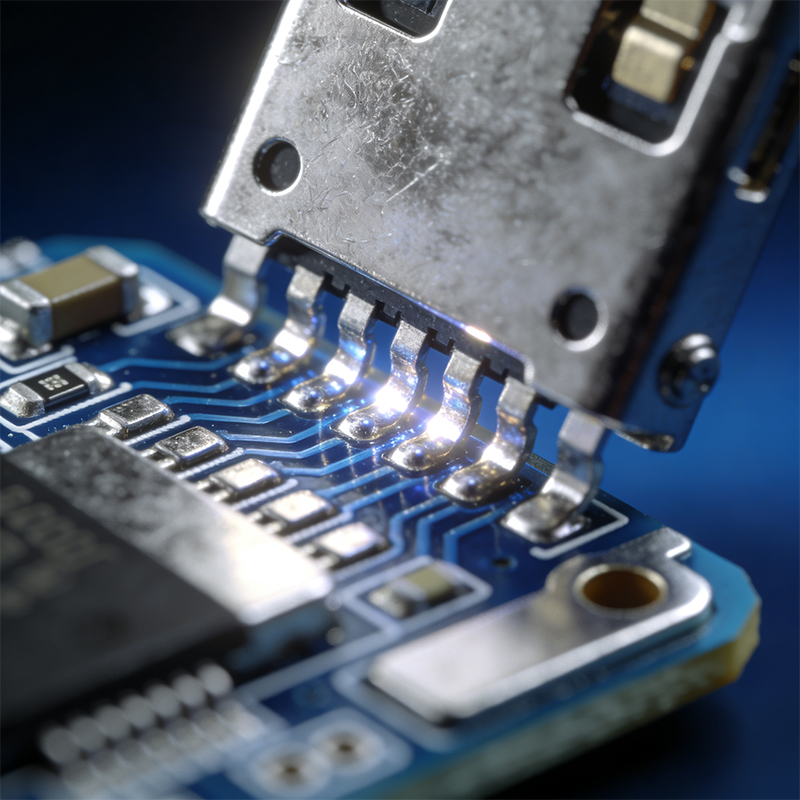
If you've ever wondered what happens when your boards go through an SMT line, here's the breakdown:
It starts with a stainless steel stencil—laser-cut with openings that match your PCB pads. The stencil aligns over the board, and solder paste (a grayish mixture of tiny solder spheres and flux) gets spread across it .
This step is critical. Too little paste, and joints are weak. Too much, and you get shorts between pins. The stencil design itself matters—engineers check things like area ratio (>0.66) and aspect ratio (>1.5) to ensure clean paste release .
Before components go on, many lines use 3D SPI to check the paste deposits—height, volume, alignment . Catching problems here saves headaches later.
This is where the magic happens. High-speed machines use vacuum nozzles to pick components from reels and trays, then place them onto the wet solder paste .
For tiny parts like 0402 capacitors, accuracy matters. For big ones like BGAs and connectors, it matters even more. The machines use vision systems to align everything perfectly .
Now the boards enter a reflow oven—a long tunnel with multiple temperature zones. The profile is carefully controlled :
Preheat: Gradually brings the board to about 150°C
Soak: Activates the flux, cleans the surfaces
Reflow: Peaks around 235-250°C (for lead-free solder), melting the paste
Cooling: Controlled cooldown solidifies the joints
Take SAC305 solder as an example—it melts around 217°C, so your peak needs to be above that but generally under 250°C to avoid damaging components .
After reflow, boards get checked:
AOI looks for missing parts, polarity, solder bridges
X-ray sees inside hidden joints like BGAs and QFNs
ICT checks for shorts and opens electrically
Functional test powers up the board to verify it actually works
SMT dominates, but through-hole isn't dead. Here's when each makes sense :
| Factor | SMT | Through-Hole |
|---|---|---|
| Signal integrity | Excellent (low parasitics) | Poor for high-frequency |
| Mechanical strength | Needs reinforcement | Naturally strong |
| Assembly speed | High (>100k CPH) | Slow |
| Cost at scale | Low | Higher |
| Rework | Complex (hot air needed) | Easier (soldering iron) |
| Best for | ICs, passives, high-density | Connectors, power parts, vibration environments |
Many modern boards use mixed assembly: SMT for most components, through-hole for connectors and parts that need extra strength .
SMDs come in all shapes and sizes :
Passive components (resistors, capacitors, inductors) use package codes like:
1206 (3.2×1.6mm) – Good for power, easy to hand-solder
0805 (2.0×1.2mm) – Common general-purpose
0603 (1.6×0.8mm) – The workhorse of mass production
0402 (1.0×0.5mm) – High-density, hard to hand-solder
0201 (0.6×0.3mm) – Extreme miniaturization, RF applications
Active components include:
SOT-23 – Common for transistors, diodes
SOIC, TSSOP, QFP – ICs with visible leads
QFN, DFN – Leadless packages, better performance
BGA – Ball grid array, hundreds of connections underneath
A few things separate good assembly from constant rework:
Solder paste management. Paste needs refrigeration, and once opened, should be used within hours. It also needs to warm to room temperature before use .
Stencil design. Apertures must match pad geometry. For fine-pitch parts, special shapes like "home-plate" or "window-pane" designs help control solder volume and prevent bridging .
Temperature profile. Every board has its own thermal needs. A generic profile might overheat sensitive parts or under-heat large ones. Experienced assemblers tune the profile to your specific board .
Component handling. Moisture-sensitive devices (MSDs) need special care. If they absorb humidity, the "popcorning effect" during reflow can crack packages. Baking might be required .
Look, SMT assembly isn't just about having machines. It's about knowing how to use them. At Kaboer, we've been at this since 2009—sixteen years of building boards for companies around the world.
Our Shenzhen facility runs modern SMT lines equipped for the full spectrum of work:
Component sizes from 0201 up to large BGAs and fine-pitch ICs
High-speed placement with precision accuracy
Multi-zone reflow ovens for precise thermal profiling
Comprehensive inspection including AOI, X-ray, and functional testing
Here's what sets us apart: we don't just assemble boards—we fabricate them too. That means:
One partner, one quality standard for your whole project
No finger-pointing between board fab and assembler
Faster turnaround because everything happens under one roof
We offer the full spectrum of custom boards, all available with integrated SMT assembly:
Flexible PCBs (FPC) : 1-20 layers, 0.075mm to 0.4mm thick – Ideal for wearables and compact designs
Rigid-Flex Boards: 2-30 layers – Rigid where you need stability, flexible where you need movement
Rigid PCBs: 1-30 layers – From standard FR-4 to high-performance materials
HDI High-Density Boards: Microvias, fine lines, advanced stackups
High-Frequency Boards: Low-loss materials including Rogers and PTFE
Metal-Core Boards: Aluminum or copper base for excellent heat dissipation
We're certified to international standards:
ISO 9001:2015 – Quality Management
IATF 16949:2016 – Automotive
ISO 14001:2015 – Environmental Management
UL and RoHS compliance
Our assembled boards meet IPC Class 2 and Class 3 requirements for applications that demand the highest reliability.
We're in Shenzhen—right in the middle of the electronics world. And we're genuinely happy to have visitors. Walk the floor, meet the team, see how your boards are assembled.
Because at the end of the day, trust isn't built on promises. It's built on transparency.
SMT technology doesn't have to be complicated. The right partner makes all the difference.
If you need custom SMT assembly or have questions about PCBA solutions, send us your Gerber files or requirements. We'll get back to you with a free quote within 2 hours.
Better yet—come visit us in Shenzhen. See for yourself how we turn components into finished, working boards.

Kaboer manufacturing PCBs since 2009. Professional technology and high-precision Printed Circuit Boards involved in Medical, IOT, UAV, Aviation, Automotive, Aerospace, Industrial Control, Artificial Intelligence, Consumer Electronics etc..


 English



 Wechat
 +86 13670210335
 +86 13670210335
 E-mail