
Date: 2026-07-15
You're designing an electronic product. Maybe an industrial controller, a telecom base station, an automotive system, or an AI server module. Your design keeps getting more complex — more components, faster signals. You've pushed your double-sided board to its limits, signal integrity is a nightmare, and the product just won't work reliably.
You need a multilayer circuit board.
A multilayer circuit board is a board with three or more conductive copper layers. Compared to single-sided and double-sided boards, multilayer boards separate power planes, ground planes, and signal layers — giving you cleaner signals, more routing space, and smaller products. In this guide, I'll explain what multilayer circuit boards are, why you need them, what types exist, and how to choose materials and stackups. Plain English, no fluff.
The global multilayer rigid PCB market was valued at approximately $74.45 billion in 2025** and is projected to reach **$109.64 billion by 2032. The high-layer-count PCB market (8+ layers) was valued at $11.41 billion in 2025. More striking — the 18+ layer high-end multilayer board market is projected to grow at 62.4% in 2026, driven by AI servers and high-speed networking demands.
These numbers tell you one thing: multilayer circuit boards are no longer just for "high-end" products — they're becoming mainstream. AI servers, 5G base stations, autonomous driving — these technologies all run on multilayer boards.
Simply put, a multilayer circuit board is three or more layers of copper foil stacked together, separated by insulating material, and laminated under high heat and pressure.
Compared to single-sided and double-sided boards:
Single-sided: One copper layer. Simplest and cheapest — but very limited routing.
Double-sided: Copper on both sides. Better than single-sided, but still limited.
Multilayer: Three or more layers. Separate power and ground planes give signals clean reference planes.
Think of multilayer boards as "building upwards" — when you run out of ground floor space, you add more floors.
1. Not enough routing space
More components, denser designs — double-sided boards just don't have enough room. Multilayer boards give you several more "floors" to route traces.
2. Poor signal quality
High-speed signals need solid reference planes (ground or power) for signal integrity. Double-sided boards don't have dedicated ground planes — signals run over a mess of other traces.
3. EMI problems
Multilayer boards create natural capacitance between power and ground planes, filtering high-frequency noise. EMI/RFI performance is over 20dB better than double-sided boards.
4. Need miniaturization
For the same functionality, multilayer boards can reduce PCB size by 30-50%.
Multilayer boards aren't one board — they're a whole family:
By layer count: 4-layer is the most basic multilayer — typically 2 signal layers + 1 power layer + 1 ground layer. 6-layer, 8-layer, 10-layer, 12-layer... high-end applications can go to 20+ layers.
By structure:
Rigid multilayer: Standard FR4 hard boards.
Flexible multilayer: Polyimide-based, bendable.
Rigid-flex multilayer: Rigid and flex sections laminated together. Eliminates connectors, reduces weight by over 30% and volume by about 40%.
HDI multilayer: High-density interconnect — trace/space down to 0.05mm.
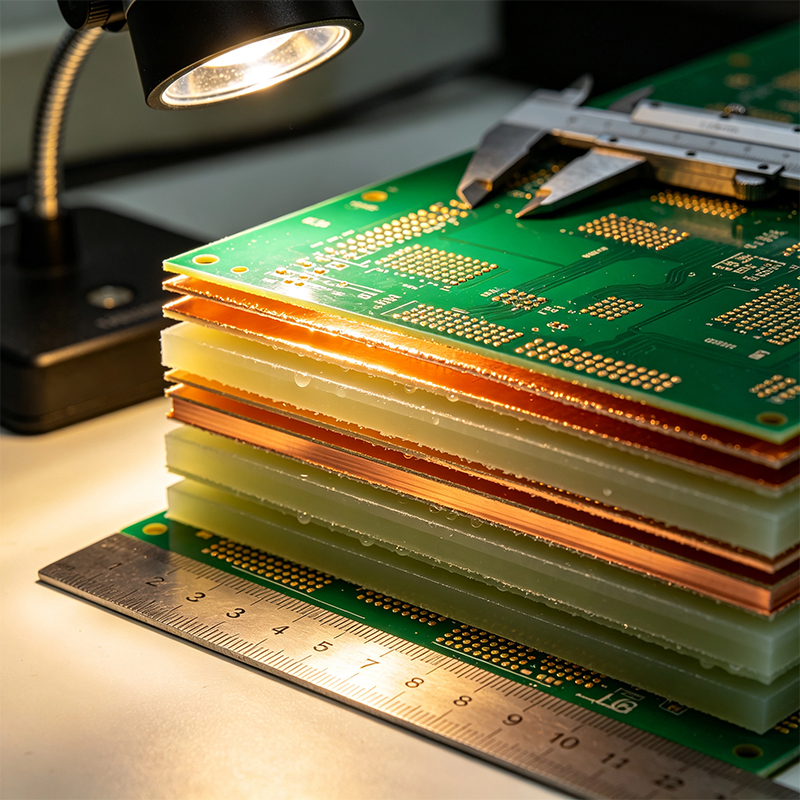
Multilayer manufacturing is far more complex than double-sided — typically involving over 200 process steps.
Core steps: Material preparation → Inner layer patterning → Lamination (the critical step — stacking and pressing layers together) → Drilling → Plating → Outer layer → Solder mask → Surface finish → Testing.
Stackup design is the first and most critical step. Good stackup design balances signal integrity, power integrity, impedance control, and mechanical stability.
Choose the right material, and your board survives its environment.
FR4: The most common, best value. Works for most everyday applications.
High-frequency materials (Rogers, PTFE) : Minimal signal loss — for 5G and radar.
Polyimide (PI) : High-temperature resistant and flexible — for flex and rigid-flex.
Hybrid stackups: Rogers for high-speed signal layers, FR4 for power/ground.
We are not a standard rigid-only PCB shop. We are a one-stop manufacturer that designs and makes flexible PCBs, rigid-flex boards, HDI high-frequency boards, and then does full PCBA.
All in-house: Multilayer fabrication and PCBA assembly under one roof.
Multilayer expertise: 4-layer to 20+ layers. FR4, Rogers, PTFE, LCP — we've done them all.
HDI capability: 1-order to any-layer HDI, minimum trace/space 0.05mm, minimum laser blind via 0.075mm.
Rigid-flex multilayer: Proven rigid-flex experience — no cracks at the rigid-flex transition.
Turnkey PCBA: High-precision placement, SPI, AOI, X-Ray, functional test — multilayer assembly is harder than double-sided, and we have the full solution.
Free DFM review: Send your design files, get a DFM report within 24 hours — including stackup design, impedance control, and manufacturability assessment.
Three simple steps:
Send your files: Gerbers, BOM, stackup and impedance requirements.
We review and quote: Within 24 hours, you'll receive a DFM report, stackup recommendation, and sample/volume pricing.
Sample, then scale: We build samples. You test functionality and reliability. Then we move to volume.
Multilayer circuit boards aren't "more expensive boards" — they're solutions to density, signal, and interference problems. The global multilayer rigid PCB market has already surpassed $74 billion, and 18+ layer boards are growing at over 62% annually. If you're still pushing double-sided boards beyond their limits, it's time to consider multilayer.
If you're looking for a manufacturer that understands multilayer — especially rigid-flex multilayer and high-frequency HDI multilayer — send us your requirements. We won't push a contract — we'll first run a free DFM review and stackup recommendation, and let our expertise speak.
When you contact us, please include:
Product type and application
Estimated layer count and whether flex/rigid-flex is needed
Estimated annual quantity (samples, small batch, or mass production)
We'll give you an honest answer — what we can do, what we can't, and how to modify your design to make it work.

Kaboer manufacturing PCBs since 2009. Professional technology and high-precision Printed Circuit Boards involved in Medical, IOT, UAV, Aviation, Automotive, Aerospace, Industrial Control, Artificial Intelligence, Consumer Electronics etc..


 English



 Wechat
 +86 13670210335
 +86 13670210335
 E-mail