
Date: 2026-06-18
You've definitely seen a circuit board before. Green, stiff, covered in copper traces and solder points. But have you ever thought about what the board itself is actually made of? Why are some boards green and others yellow? Why do some bend while others crack if you try?
The answers are all in the PCB materials.
In this guide, I'll walk you through the most common PCB circuit board materials in plain English. By the end, you'll know what FR4 means, why Rogers is so expensive, and what flexible boards are made of.
A complete PCB isn't made of just one material. It's a sandwich of several different layers pressed together. From top to bottom:
Soldermask: The green (or red, or blue) layer you see on top. It protects the copper from oxidation and prevents solder bridges during assembly.
Copper foil: The thin copper traces that carry electricity and signals.
Substrate: The "skeleton" of the board that holds everything together.
Prepreg: The glue that bonds the layers together.
The most important part — the one that really determines performance — is the substrate material. What substrate you choose decides where the board can be used, what frequencies it can handle, and how much heat it can take.
FR4 is the most widely used PCB material in the world. About 70-80% of all PCBs are made from FR4. FR4 stands for "Flame Retardant Level 4" — in plain English, it doesn't catch fire easily.
It's made from woven fiberglass cloth impregnated with epoxy resin. Think of it as layers of glass fabric glued together and pressed into a solid sheet. Key specs for FR4:
Dielectric constant (Dk): about 4.2-4.8 — determines how fast signals travel
Loss tangent (Df): about 0.015-0.02 — higher means more signal loss
Glass transition temperature (Tg): standard FR4 is 130-140°C; high-Tg FR4 goes to 170-180°C. Tg is the temperature where the board starts to soften
Why is FR4 so popular? Three words: cheap and good enough. Most consumer electronics, industrial controls, automotive ECUs, and IoT devices don't need anything fancier. But FR4 has a clear weakness: it struggles at high frequencies. Above 3-6GHz, signal loss becomes a real problem. So for 5G, radar, and satellite communications, FR4 just won't cut it.
If your product needs to handle high-frequency signals — think 5G antennas, radar, satellite communications — you need Rogers materials.
Rogers is a company that makes PCB materials specifically designed for high-frequency applications. The big difference from FR4: Rogers uses ceramic-based or hydrocarbon materials instead of fiberglass. Key specs for Rogers:
Dielectric constant (Dk): about 2.2-3.5 (much lower than FR4 — signals travel faster)
Loss tangent (Df): about 0.001-0.004 (an order of magnitude lower than FR4 — minimal signal loss)
Thermal stability: much better than FR4 — performance barely changes with temperature
Common Rogers grades include RO4000 series (RO4350B, RO4003C) and RO3000 series. The upside is exceptional signal quality and minimal loss. The downside? Expensive. Rogers costs 5-10 times more than FR4 for the same area. That's why it's only used where it's absolutely necessary — 5G mmWave antennas, automotive radar, aerospace communications.
FR4 and Rogers are both rigid — they don't bend. So what do flexible circuit boards use? The answer is polyimide (PI).
Polyimide is a high-performance plastic film. DuPont makes a famous brand of it called Kapton. Its biggest feature? It's flexible. Flex PCBs can bend, fold, and roll because of polyimide. Key specs for polyimide:
Tg: 250-400°C — much higher than FR4 or Rogers
Operating temperature: -200°C to over 260°C
Dielectric constant: about 3.5 — between FR4 and Rogers
Bendable: can survive tens of thousands of bends without cracking
Polyimide is used in flexible PCBs and rigid-flex boards — think wearables, foldable displays, medical implants, aerospace. The downside, like Rogers: expensive and harder to process.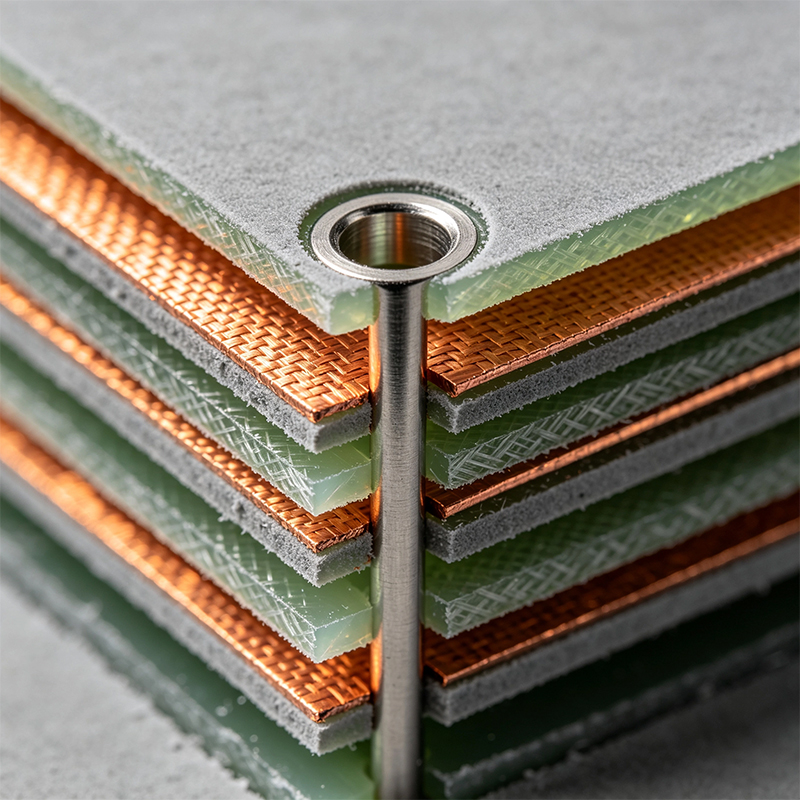
If your product has high-power LEDs or components that get really hot, standard FR4 might not cut it. FR4's thermal conductivity is only 0.3-0.4 W/m·K — it doesn't move heat well. That's where aluminum-core PCBs come in.
Aluminum PCBs have thermal conductivity of 1-3 W/m·K — several times better than FR4. They're made of three layers: copper foil, insulation layer, and aluminum base. The aluminum's job is to pull heat away quickly so your LEDs or power chips don't burn up. Aluminum PCBs are common in LED lighting, automotive lighting, and power modules.
There's also copper-core PCB for extreme power applications, with thermal conductivity around 400 W/m·K.
With all these materials, how do you decide? Look at three things:
1. Glass Transition Temperature (Tg)
Tg is the temperature where the board starts to soften. Higher Tg means better heat resistance. Lead-free soldering runs hot, so high-Tg materials are more reliable for those processes.
Standard FR4: 130-140°C
High-Tg FR4: 170-180°C
Polyimide: 250-400°C
2. Dielectric Constant (Dk) and Loss Tangent (Df)
Dk determines how fast signals travel. Df determines how much signal is lost as heat. High-frequency applications need low Dk and low Df.
FR4: Dk≈4.5, Df≈0.02
Rogers: Dk≈2.2-3.5, Df≈0.001-0.004
Polyimide: Dk≈3.5, Df≈0.0027
3. Coefficient of Thermal Expansion (CTE)
CTE is how much the material expands when heated. Lower is better — otherwise, vias can crack during thermal cycling. Rogers has CTE that matches copper very closely, which is why it's so reliable.
PCB circuit board materials, boiled down to the essentials:
FR4: Cheap and good enough. Covers 80% of the market. Works for most everyday electronics.
Rogers: Expensive but excellent signal quality. For 5G, radar, RF.
Polyimide (PI) : Flexible and heat-resistant. For flex boards and wearables.
Aluminum core: Great heat dissipation. For LEDs and power circuits.

Kaboer manufacturing PCBs since 2009. Professional technology and high-precision Printed Circuit Boards involved in Medical, IOT, UAV, Aviation, Automotive, Aerospace, Industrial Control, Artificial Intelligence, Consumer Electronics etc..


 English



 Wechat
 +86 13670210335
 +86 13670210335
 E-mail