
Date: 2026-03-02
Ever opened a laptop and noticed how multiple circuit boards are stacked inside, connected by tiny connectors or flexible cables? That's "PCB on PCB" in action—a design approach where multiple printed circuit boards work together as a system, connected through various methods rather than being one single large board.
Think of it like building with LEGO bricks instead of a single solid block. You can swap pieces, upgrade modules, and fit everything into tighter spaces. That's exactly why electronics manufacturers use PCB-on-PCB designs—it makes products more modular, easier to manufacture, and simpler to repair.
This guide explains the different ways boards connect to boards, when you'd use each method, and what to consider when designing stacked or connected PCB systems.
"PCB on PCB" isn't a formal technical term—it's a practical way of describing situations where one circuit board attaches to another. This happens in several common scenarios:
Daughterboard on motherboard: A smaller board plugs into a larger main board (like a Raspberry Pi HAT)
Mezzanine boards: Boards stacked parallel with spacers, connected through connectors
Rigid-flex designs: Flexible circuits connecting multiple rigid board sections
Module-on-board: Pre-built functional modules (like Bluetooth or power modules) mounted on a main PCB
Card-edge connections: Boards sliding into slots on a backplane (like PCIe cards in a computer)
The core idea is the same: instead of building everything on one giant board, you split the system into smaller, interconnected boards that work together.
Modern products demand maximum functionality in minimal space. Stacking boards lets you use three dimensions instead of just two. A smartphone would be twice as large if everything had to fit on one plane .
When functions are separated onto different boards, you can upgrade or replace individual modules without redesigning everything. Need better wireless? Swap the RF module. Want more processing power? Upgrade the CPU board. This modular approach extends product life and simplifies field service .
Smaller boards are often easier to manufacture with higher yields than one massive complex board. If one functional module has issues, you can rework or replace just that board instead of scrapping an entire expensive assembly .
Sensitive analog circuits can be separated from noisy digital sections on different boards, connected only where necessary. This reduces interference and improves overall performance .
Heat-generating components can be placed on separate boards with dedicated cooling, preventing hot spots from affecting sensitive circuits elsewhere.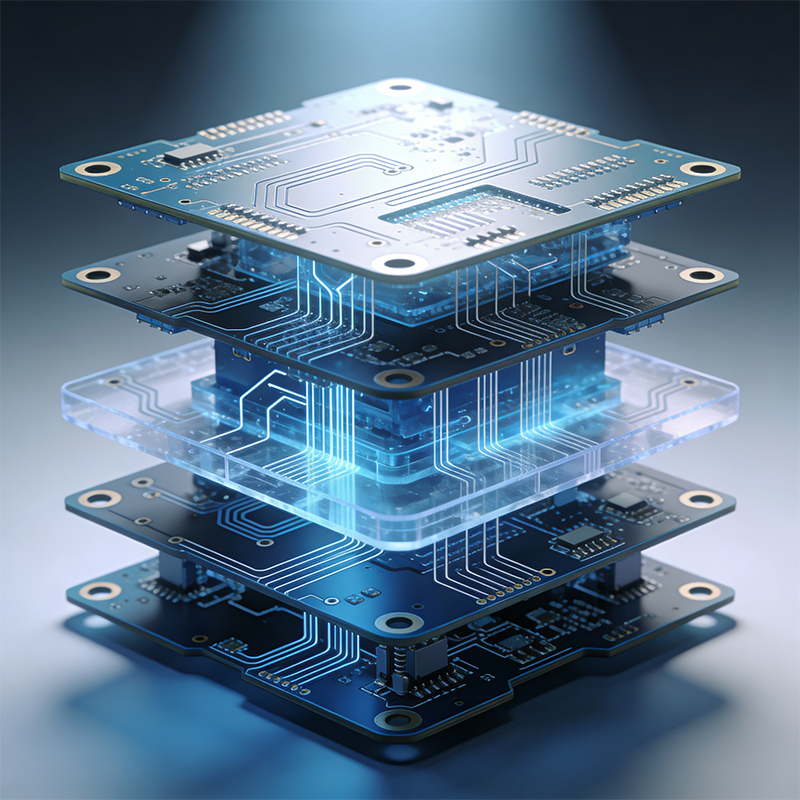
This is the most straightforward method. Two boards connect using mating connectors—one soldered to each board. Types include:
Pin header and socket headers: The classic 2.54mm pitch connectors, cheap and reliable for low-density connections
Mezzanine connectors: Designed for parallel stacking with controlled spacing, common in computer modules
High-speed board-to-board connectors: For signals running at gigabytes per second, with controlled impedance and shielding
When to use: When boards need to be separable, when you need moderate to high connection counts, or when mechanical stability matters.
One board has gold-plated contacts along its edge that slide into a matching slot on another board. You've seen this in every PCIe card and memory module.
Advantages: No connector on the daughterboard reduces cost, reliable connection, supports high speeds. PCIe 5.0 and 6.0 continue using this format for AI accelerator cards and high-performance computing .
When to use: For modular systems where boards are inserted and removed occasionally, like servers, test equipment, or expansion cards.
Rigid-flex boards combine rigid sections with flexible circuits connecting them. This eliminates connectors entirely, improving reliability and saving space .
Advantages: No connector reliability issues, continuous signals without impedance breaks, foldable into tight spaces.
When to use: In compact consumer products (smartphones, laptops), medical devices, aerospace applications where vibration resistance is critical.
Pins are pressed into plated-through holes without solder, creating a gas-tight connection. Common in backplane and power electronics applications.
Advantages: No soldering, easy repair, handles high current well.
When to use: High-reliability industrial systems, power distribution, applications requiring field service.
Sometimes one board is soldered directly to another using through-hole or surface-mount techniques, often with support pins or spacers for mechanical stability.
Advantages: Lowest cost, good mechanical strength, simple.
When to use: Permanent connections in cost-sensitive consumer products.
When connecting boards, you need to ensure they align properly and stay connected under vibration and shock :
Use tooling holes and alignment pins during assembly
Add mechanical standoffs or spacers to maintain correct spacing
Consider the mating force of connectors—can your enclosure withstand repeated insertions?
Account for tolerances in board thickness and connector placement
Every connection between boards is a potential signal integrity nightmare if not designed carefully :
For high-speed signals, use connectors rated for your frequency (don't use cheap pin headers for PCIe)
Keep differential pairs together through the connector
Match trace lengths to the connector pins
Consider the return current path—connectors should have enough ground pins to maintain low inductance
Simulate the entire channel including connectors, not just the board traces
Delivering power across board boundaries requires attention :
Use multiple pins for high-current connections to reduce resistance
Consider voltage drop across the connection—may need higher voltage at the source
Add bulk capacitance on each board to handle transient demands
For sensitive analog circuits, consider separate power connections to avoid digital noise coupling
Heat doesn't stop at board boundaries :
Identify hot components on each board
Ensure airflow can reach all boards in a stack
Consider thermal conduction paths through connectors (some high-power connectors are designed for this)
May need heat spreaders or thermal vias to move heat to enclosure
Stacked boards create assembly challenges :
Can your assembly house handle double-sided placement on both boards?
Will connectors survive reflow temperatures? Some need hand-soldering after reflow.
Consider test access—can you probe each board after assembly?
Plan for rework—can a failed board be replaced without destroying the assembly?
Stacked boards can create cavities that act as resonators :
Maintain continuous ground planes across connections
Add grounding springs or gaskets between boards if needed
Keep noisy sections away from sensitive circuits in the stack
Consider the stack as a whole system, not isolated boards
| Situation | Choose PCB-on-PCB | Choose Single Board |
|---|---|---|
| Space constraints | ✓ Stacking saves footprint | Simple designs with space |
| Modularity needed | ✓ Upgradeable modules | Fixed-function products |
| High-volume cost | May cost more | Usually lower cost at scale |
| Signal speed | Can work well | Better for ultra-high speed |
| Thermal management | ✓ Separate hot sections | Challenged with hot spots |
| Repair/service | ✓ Modules replaceable | Must replace entire board |
| Vibration resistance | Connectors vulnerable | ✓ More robust if single |
| Development time | ✓ Parallel module development | Longer for complex boards |
Modern phones use multiple rigid-flex boards: main logic board, camera modules, display drivers, battery management—all connected through flex circuits folded into the tight enclosure.
Servers use backplanes with multiple cards plugged in—CPU boards, memory risers, storage controllers, network interface cards. Each card can be upgraded independently, and failed cards replaced without shutting down the whole system .
Patient monitors often use modular designs: a main board with plug-in parameter modules for ECG, blood pressure, temperature. Hospitals can configure monitors for their needs and swap modules for service .
PLC systems use racks with multiple I/O modules plugged into a backplane. Users add exactly the inputs and outputs they need, and modules can be replaced without rewiring.
Modern vehicles have dozens of electronic modules connected through networks, but some subsystems (like engine control) may use stacked boards within a single enclosure to save space under the hood.
As electronics continue shrinking, PCB-on-PCB designs are evolving :
HDI and microvia technology allows finer pitch connectors and more connections in less space
Embedded components inside the board reduce need for surface-mount parts on both sides
Optical interconnects may eventually replace some electrical connections for ultra-high-speed signals
3D-printed electronics could enable truly three-dimensional interconnect structures
Advanced materials like low-loss laminates support higher speeds across board boundaries
The trend is clear: instead of one massive board, future electronics will use multiple specialized boards working together in harmony, connected through increasingly sophisticated methods.
At Kaboer, we've spent over 16 years mastering the art of connecting boards to boards. Based in Shenzhen, China, we understand that modern electronics demand sophisticated interconnect solutions—whether that's flexible circuits folding between rigid sections, high-speed connectors carrying PCIe signals, or complex rigid-flex assemblies that eliminate connectors entirely.
We specialize in the technologies that make PCB-on-PCB designs work:
Flexible PCBs (FPC) : 1-16 layers, thickness from 0.075mm to 0.4mm. Perfect for connecting boards in tight spaces, folding around corners, and surviving thousands of flex cycles.
Rigid-Flex Boards : 2-16 layers combining rigid sections with flexible interconnects. Eliminates connectors entirely, improves reliability, and saves space. Ideal for medical devices, aerospace, and compact consumer products.
HDI and High-Frequency Boards : With capabilities down to 2mil line width and spacing and 2mil microvias, we handle the demanding signal integrity requirements of high-speed board-to-board connections. Our multi-order HDI technology supports complex stacking and fine-pitch BGA escape routing .
PCBA Services : Our in-house assembly means we don't just make the boards—we populate them with connectors and components, ensuring every connection meets our stringent quality standards.
We're certified to international standards including ISO 9001:2015, IATF 16949:2016, ISO 14001:2015, and UL. Our monthly capacity exceeds 15,000 square meters for flexible and rigid-flex boards, plus 8,000 square meters for rigid PCBs .
We believe the best partnerships are built on trust and transparency. That's why we warmly welcome our global clients to visit our factory in Shenzhen. See our advanced manufacturing lines, meet our engineering team, and discuss your PCB-on-PCB challenges face-to-face.
Whether you're designing a complex server backplane, a compact medical device with rigid-flex interconnects, or a modular industrial control system, we have the expertise and capability to make your project successful.
Ready to discuss your next project? Contact us today to learn how Kaboer can help you build electronics that last. Better yet—come visit us in Shenzhen and see for yourself.

Kaboer manufacturing PCBs since 2009. Professional technology and high-precision Printed Circuit Boards involved in Medical, IOT, UAV, Aviation, Automotive, Aerospace, Industrial Control, Artificial Intelligence, Consumer Electronics etc..


 English



 Wechat
 +86 13670210335
 +86 13670210335
 E-mail