
Date: 2026-02-27
Ever wonder how the electronics in a car's engine bay survive years of heat, vibration, and road salt? Or how a submersible water pump runs underwater without shorting out? The answer often lies in a protective process called PCB potting.
Potting is exactly what it sounds like—you "pot" the circuit board, encasing it in a solid or gel-like material that seals it off from the outside world. Think of it like putting your electronics in a custom-fit block of tough, protective plastic that keeps everything bad out and everything good in.
Here's the plain English version: potting means taking an assembled circuit board and surrounding it completely with a liquid resin that later hardens into a solid block . That block becomes part of the device itself, providing a fortress-like barrier against moisture, shock, vibration, and all the other nasties that kill electronics.
This guide walks you through everything you need to know about potting—what it is, why you'd use it, what materials to choose, and how to get it right.
At its simplest, PCB potting is encasing an electronic assembly in a protective polymer . A liquid compound—usually epoxy, polyurethane, or silicone—is poured or injected into a housing that contains the PCB. Once it cures, it forms a solid, monolithic block that completely surrounds every component, every solder joint, every delicate trace .
This is very different from a conformal coating, which is just a thin film (typically 25-75 microns thick) sprayed or brushed onto the board's surface . Think of conformal coating like a rain jacket—it keeps light moisture off but offers little protection against a beating. Potting is more like an armored personnel carrier—it's heavy, it's tough, and it'll survive things that would destroy a jacket.
The key differences :
Thickness: Conformal coating is measured in microns; potting is measured in millimeters or even centimeters.
Protection level: Potting handles heavy vibration, impact, and full immersion. Conformal coating deals with dust and light moisture.
Reworkability: Conformal coating can often be stripped or soldered through. Potting? Once it's on, it's practically permanent. Repair becomes extremely difficult or impossible .
Weight and bulk: Potting adds significant weight and takes up space. That's the price you pay for ruggedness.
Engineers don't choose potting lightly—it adds cost, weight, and complexity. But when the environment is harsh enough, the benefits outweigh everything else.
Moisture is public enemy number one for electronics. It causes corrosion, short circuits, and that nasty "dendritic growth" where metal literally grows between traces and bridges them. Potting creates a hermetic or near-hermetic seal that locks out water, humidity, salt spray, dust, and chemical vapors .
Industrial environments throw oils, fuels, solvents, and cleaning agents at electronics. Unprotected boards don't stand a chance. A properly potted board laughs them off.
In cars, aircraft, and industrial machinery, electronics get shaken constantly. Solder joints fatigue and crack. Heavy components like capacitors can snap right off the board. Potting holds everything rigidly in place, distributing mechanical stress throughout the solid block rather than concentrating it on joints . The potting compound acts as a giant shock absorber.
Here's a twist: while some potting materials insulate, many are specifically engineered to conduct heat . By filling the air gaps around hot components, thermally conductive potting compounds (loaded with ceramic or other fillers) provide a path for heat to escape to the enclosure or a heatsink. This can actually cool components better than still air.
Potting compounds have high dielectric strength—they're excellent electrical insulators . This prevents arcing and corona discharge in high-voltage circuits, allowing components to be spaced closer together than safety would otherwise permit.
Once potted, a circuit board becomes very difficult to access. The resin obscures components and traces, making reverse engineering a serious challenge . If you're protecting intellectual property or preventing tampering, potting is your friend.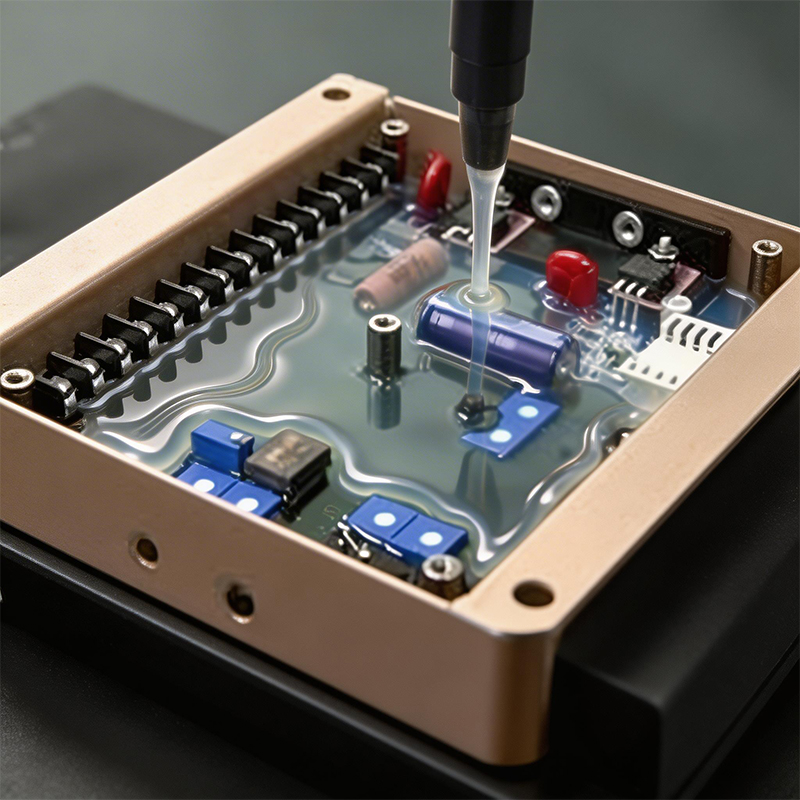
Choosing the right compound is the most critical decision in potting. There's no universal best—only what's best for your specific application .
Epoxies are the most common potting materials, prized for their hardness, strength, and chemical resistance . Once cured, they form a rigid, durable shell that stands up to mechanical abuse and harsh chemicals.
Strengths :
Excellent mechanical strength and rigidity
Superior chemical and solvent resistance
High temperature resistance (up to 200°C in some formulations)
Strong adhesion to most substrates
Good electrical insulation
Can be filled for high thermal conductivity
Generally cost-effective
Weaknesses :
Rigidity can be a problem during thermal cycling—if the coefficient of thermal expansion (CTE) mismatches components, stress can crack solder joints or even components
Brittle at low temperatures
Exothermic curing reaction generates heat (can damage sensitive parts)
Practically impossible to rework or repair
Shrinkage during curing can stress components
Best for : Static applications with minimal thermal cycling, high-temperature environments, exposure to aggressive chemicals, high-voltage insulation, and situations where maximum mechanical strength is needed.
Polyurethanes (often called urethanes) offer a balance of toughness and flexibility . They're softer than epoxies, which makes them gentler on sensitive components.
Strengths :
Good flexibility, reducing stress on components during thermal cycling
Excellent low-temperature performance (down to -40°C)
Good moisture resistance
Easier to process than some materials
Moderate cost
Weaknesses :
Lower maximum operating temperature (typically below 130°C)
Less chemical resistance than epoxies
Can be sensitive to moisture during curing
Not as tough mechanically as epoxies
Best for : Applications with significant thermal cycling, automotive electronics, outdoor equipment, and situations where components need protection from stress.
Silicones are the premium choice for extreme temperature ranges and maximum flexibility . They remain soft and rubbery from way below freezing to scorching hot.
Strengths :
Widest operating temperature range (typically -50°C to +200°C, some even wider)
Excellent flexibility—minimal stress on components
Good UV and weathering resistance
Maintains properties across temperature extremes
Good dielectric properties
Weaknesses :
Highest cost of the three
Low mechanical strength and tear resistance
Poor adhesion to many substrates (may require primers)
High CTE can sometimes cause issues
Can absorb small molecules and swell
Best for : Extreme temperature environments, aerospace and defense applications, sensitive components that can't handle stress, and applications requiring optical clarity.
| Property | Epoxy | Polyurethane | Silicone |
|---|---|---|---|
| Hardness | Rigid/hard | Flexible | Very soft/rubbery |
| Temperature range | Good up to 200°C | Moderate (to 130°C) | Excellent (-50°C to 200°C+) |
| Chemical resistance | Excellent | Good | Good |
| Mechanical strength | Excellent | Good | Poor |
| Stress on components | High (rigid) | Low (flexible) | Very low |
| Cost | Low-moderate | Moderate | High |
| Reworkability | Impossible | Very difficult | Difficult |
| UV resistance | Fair | Good | Excellent |
| Adhesion | Excellent | Good | Poor (needs primer) |
Potting isn't for every product. But when you need it, you really need it.
Modern cars are rolling electronics platforms. Under the hood, electronics face temperature extremes, constant vibration, oil, fuel, and road salt . Battery management systems (BMS), onboard chargers, motor controllers, and sensors all get potted to survive . Tire pressure monitoring systems (TPMS) live inside wheels—they're potted to handle the abuse .
Factory floors are nasty places. Motor drives, power supplies, and controllers deal with vibration, metal shavings, coolant mists, and electrical noise . Potting keeps them running.
Solar inverters and wind turbine controllers sit outside year-round, facing rain, snow, UV, and temperature swings . Potting is standard practice.
Anything that goes underwater needs protection. Navigation equipment, underwater sensors, and pumps rely on potting to keep water out .
Avionics and flight controls must function in unpressurized environments, extreme temperature swings, and high G-forces . Failure is not an option, so potting is common.
Potting prevents arcing and corona discharge in power supplies, inverters, and other high-voltage gear . It lets designers pack components tighter while maintaining safety margins.
High-end outdoor gear, underwater cameras, and some wearables use potting to achieve high IP ratings (water and dust resistance) .
Potting isn't something you just do at the end. You have to design for it from the start .
Some components can't be potted—things that need to move (relays, switches) or breathe (certain sensors, microphones). Plan ahead.
Orient tall components to help resin flow. Leave space between parts so the compound can reach everywhere. Create "flow channels" on the board if needed .
Air bubbles trapped in the potting compound are bad news . They create paths for moisture, weaken the structure, and can cause localized heating. Prevention methods :
Vacuum degassing before dispensing removes bubbles from the mixed resin
Vacuum potting pulls air out of tight spaces during filling
Slow, controlled pouring lets air escape
Proper venting in the housing design
The mismatch in thermal expansion between components, the PCB, and the potting compound can cause stress during temperature changes . Solutions:
Choose a flexible compound (lower modulus) for high-cycling applications
Use "glob-top" or underfill on large BGAs or QFNs before global potting
Match CTE where possible
Curing isn't just "wait for it to harden." Temperature matters . Heat accelerates curing and can improve final properties, but too much heat during the exothermic reaction can damage components. Follow the manufacturer's recommended cure schedule.
Here's the hard truth: once potted, repair is usually impossible . If a component fails inside a potted assembly, the whole thing is typically scrap. That means your testing before potting must be absolutely solid. You're making a "commitment to quality" at the potting stage .
When you're sitting down to select a potting material, work through these questions :
What are the environmental threats? List them: moisture? chemicals? vibration? temperature extremes? salt spray? UV?
What's the operating temperature range? Both the continuous range and any excursions matter. This will narrow your material options significantly.
What's the thermal cycling profile? How many cycles? How fast? How wide? Flexible materials handle cycling better.
Are there high voltages? If so, you need high dielectric strength and maybe higher thickness.
Does heat need to be conducted away? If components run hot, you need a thermally conductive compound.
What's the production volume and process? Fast production might need fast-curing materials. Complex shapes might need low-viscosity compounds that flow well.
Any special requirements? Optical clarity? UL94 flame rating? Low outgassing for space applications?
What's the budget? Silicone costs more than epoxy. There's no free lunch.
PCB potting is the ultimate protection for electronics that have to survive harsh environments. It's not a decision to make lightly—it adds cost, weight, and complexity, and it kills repairability. But when your product needs to endure vibration, moisture, chemicals, and extreme temperatures, nothing else comes close .
The key is matching the material to the mission:
Epoxy when you need maximum strength and chemical resistance in stable environments
Polyurethane when you need flexibility and thermal cycling performance
Silicone for extreme temperature ranges and minimal component stress
Get the material right, design for the process, control your voids, and you'll have electronics that just keep running, year after year, no matter what the world throws at them .

Kaboer manufacturing PCBs since 2009. Professional technology and high-precision Printed Circuit Boards involved in Medical, IOT, UAV, Aviation, Automotive, Aerospace, Industrial Control, Artificial Intelligence, Consumer Electronics etc..


 English



 Wechat
 +86 13670210335
 +86 13670210335
 E-mail