
Date: 2026-03-18
If you're in the business of making electronic products, you've probably seen the term PCB SMT more times than you can count. But what does it actually mean, and why should you care?
Let's break it down simply. A PCB (printed circuit board) is the bare board—the foundation. SMT (surface mount technology) is how we put components on that board. Put them together, and PCB SMT is the process of taking a bare circuit board and turning it into a functioning electronic assembly by mounting components directly onto its surface.
Think of it this way: the PCB is the skeleton, and SMT is the method we use to attach all the muscles and organs that make it alive.
The SMT assembly process follows a pretty standard sequence. Here's what happens step by step .
Solder Paste Printing
It starts with a stainless steel stencil—laser-cut with openings that match your PCB pads. The stencil aligns over the board, and solder paste (a grayish mixture of tiny solder spheres and flux) gets spread across it. This step is critical because the amount and placement of paste directly determines solder joint quality .
The stencil thickness is typically 0.12–0.15 mm, aiming for a paste deposit of 0.10–0.20 mm thick. Engineers control parameters like print speed (30–50 mm/s) and squeegee pressure (1.5–2.5 kgf/cm²) to get it just right .
Solder Paste Inspection (SPI)
Before any components go on, many lines use 3D SPI to check every paste deposit. This measures volume, height, and alignment, catching potential issues before they become expensive problems . Studies show that a high percentage of soldering defects originate at the printing stage, so catching issues here is crucial .
Component Placement
High-speed pick-and-place machines use vacuum nozzles to grab components from reels and trays, then position them onto the wet solder paste. Modern machines place components with accuracy down to ±0.01 mm . High-speed chip-shooters can place tens of thousands of small passives per hour, while multi-function placers handle complex parts like BGAs and QFPs .
Reflow Soldering
The board goes through a reflow oven—a long tunnel with multiple temperature zones. The temperature profile is carefully controlled through preheat, soak, reflow, and cooling stages . For lead-free solder like SAC305, the peak temperature typically reaches 235–250°C .
Inspection and Testing
After reflow, boards get checked thoroughly:
AOI looks for visible defects like missing parts, tombstoning, or solder bridges
X-ray inspection checks hidden joints underneath BGAs and QFNs
In-circuit test (ICT) verifies electrical connectivity
Functional test powers up the board to confirm it actually works
Here's something that's not always obvious: PCB SMT isn't one-size-fits-all. Different board types require different approaches.
For rigid boards, the process is straightforward and well-established. The stable substrate makes placement and reflow predictable .
For flexible circuits, things get trickier. Flexible PCBs can shift during processing and need proper fixturing—often using carriers—to keep them stable during printing and placement . They also absorb moisture easily and must be thoroughly pre-baked before reflow to prevent blistering and delamination .
For rigid-flex boards, you combine both worlds, which means extra attention at the boundaries where rigid and flexible sections meet .
For HDI and high-frequency boards, the tolerances get tighter. Fine-pitch components and microvias require precision equipment and careful process control .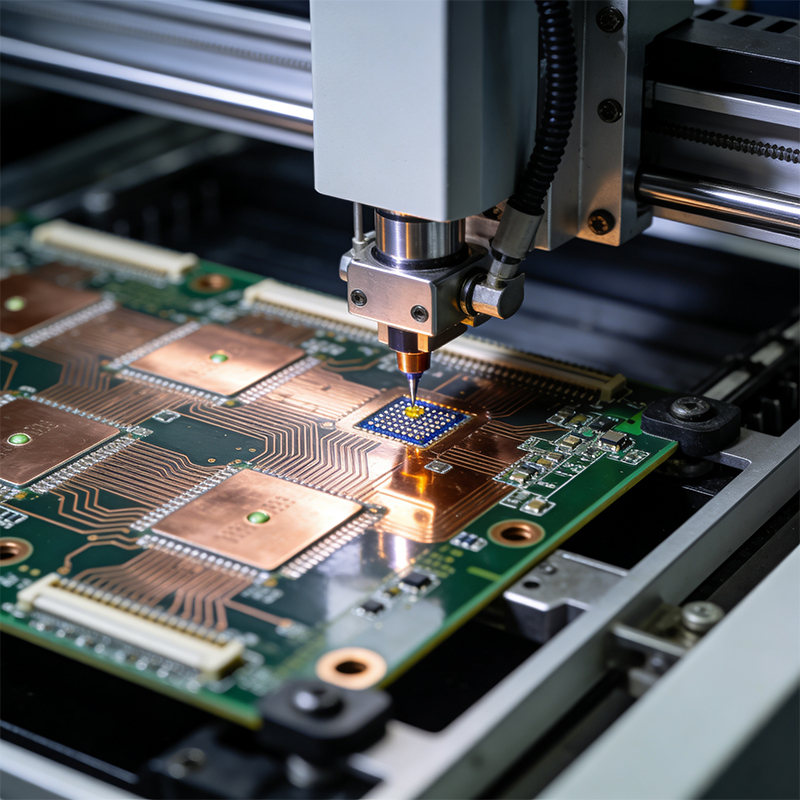
In PCB SMT, quality isn't something you inspect at the end—it's something you build into every step.
SPI (Solder Paste Inspection) catches printing defects before components are placed. This is your first line of defense .
AOI (Automated Optical Inspection) after reflow checks for visible defects. Modern 3D AOI systems measure solder joint height and volume, providing more thorough inspection than manual methods .
X-ray inspection is essential for BGAs, QFNs, and other components with hidden joints. You can't see these solder joints any other way .
Flying probe testing verifies electrical connectivity without needing custom fixtures—ideal for prototypes and low-volume runs .
PCB SMT costs break down into a few main categories :
PCB fabrication – the bare board itself
Component sourcing – buying all the parts
Assembly labor – SMT placement and any through-hole work
Testing and quality control – inspections and functional test
The good news is that SMT is highly scalable. While prototypes cost more per board, volume production brings costs down dramatically through economies of scale .
At Kaboer, we've been doing PCB SMT assembly since 2009. We're based in Shenzhen, with our own PCBA factory, and we handle the full range—from standard rigid boards to complex flexible circuits, rigid-flex boards, HDI high-frequency PCBs, and metal-core boards.
Here's what that means for you:
We handle the tricky stuff. Flexible and rigid-flex PCBs need special fixturing during SMT. We've got the processes in place .
We work with tiny components. Modern designs use 0201 and 01005 packages. Our lines are equipped to place them accurately .
We check everything. SPI before placement, AOI after reflow, X-ray for hidden joints, and functional testing at the end . We don't ship boards we haven't verified.
We can prototype fast. Need to validate a design quickly? We offer quick-turn assembly so you can catch issues early.
We welcome visitors. If you're ever in Shenzhen, you're welcome to visit our factory and see how we work.
Send us your Gerber files or requirements. We'll review your design, give you honest feedback, and get back to you with a quote. We've been at this for over 15 years, and we believe the best partnerships start with straightforward conversations.

Kaboer manufacturing PCBs since 2009. Professional technology and high-precision Printed Circuit Boards involved in Medical, IOT, UAV, Aviation, Automotive, Aerospace, Industrial Control, Artificial Intelligence, Consumer Electronics etc..


 English



 Wechat
 +86 13670210335
 +86 13670210335
 E-mail