
Date: 2026-07-13
You're designing an electronic product. Maybe an automotive controller, a medical device, an industrial sensor, or a communication module. You spent weeks on the schematic, selected every component, and built the prototype. The first production boards arrive. You power them up — they work. You ship them to your customer with confidence. Three months later, they complain about intermittent failures.
What went wrong? The step you skipped was testing.
A circuit board goes through dozens of processes — SMT placement, reflow soldering, through-hole assembly, cleaning. Every single step can introduce defects. Wrong component orientation. Solder bridges. Cold joints. You can't always see these with your eyes, but power it up and the problems show up. PCB testing is the final gate that catches these bad boards before they leave the factory.
In this guide, I'll explain what PCB testing is, why you need it, what methods exist, and which one fits your product. Plain English, no fluff.
The global PCB testing services market was valued at approximately $4.21 billion in 2025** and is projected to grow at a **CAGR of 6.20%** [0†L6-L8][7†L11-L13]. The PCB inspection equipment market reached **$4.43 billion in 2025 and is expected to hit $4.91 billion in 2026**, growing at a remarkable **10.8% CAGR** [0†L32-L34]. The PCB in-circuit tester market alone was valued at **$370 million in 2025 [0†L16-L17].
These numbers tell you one thing: PCB testing isn't optional — it's essential. As electronics get smaller, denser, and faster, testing becomes more critical and more expensive to skip.
The core goal of PCB testing is simple: ensure every board that ships is good. Specifically, it catches:
Opens: broken traces that stop signals
Shorts: unintended connections between traces
Wrong component values: wrong resistors, wrong capacitors
Reversed polarity: diodes, LEDs, electrolytic caps installed backwards
Cold joints and insufficient solder: joints that look soldered but aren't
Voids: internal voids in BGA and QFN solder joints
Each of these defects can cause a product to fail in the field.
PCB testing isn't one-size-fits-all. Different stages, volumes, and board types need different methods.
1. Bare Board Testing
Before any components are soldered on, test the bare board itself — checking for opens, shorts, and insulation resistance [8†L31-L33]. Bare board testing happens after PCB fabrication and before SMT assembly [8†L50-L51]. If the bare board has problems, populating components is a waste.
2. Automated Optical Inspection (AOI)
AOI uses high-resolution cameras to photograph the board and compare it to a reference image — automatically detecting missing parts, wrong polarity, bridging, and tombstoning [4†L14-L16]. AOI is fast, accurate, and great for high-volume production, but it only sees surfaces — BGA and QFN joints under chips are invisible to AOI [12†L21-L24]. AOI is an in-line solution that integrates seamlessly into the SMT line — boards go straight from reflow to AOI [4†L18-L19].
3. X-Ray Inspection
X-ray sees inside the board — voids, bridges, and micro-cracks in BGA and QFN joints that AOI can't touch [12†L21-L24][4†L5-L8]. Combining AOI and X-ray (sometimes integrated into a single system) allows simultaneous inspection of both surface and internal defects [4†L48-L49].
4. Flying Probe Test (FPT)
Flying probe testing doesn't require custom fixtures. Four to eight movable probes travel to each test point on the board, one at a time [10†L14-L24].
The big advantage is flexibility and no fixture cost. To switch to a different board, just change the program [10†L34-L35]. Perfect for prototypes, low-volume builds, and high-mix production.
The downside is speed — probes move sequentially, and a complex board can take minutes [2†L40-L41]. Not suitable for high-volume production [9†L38-L40].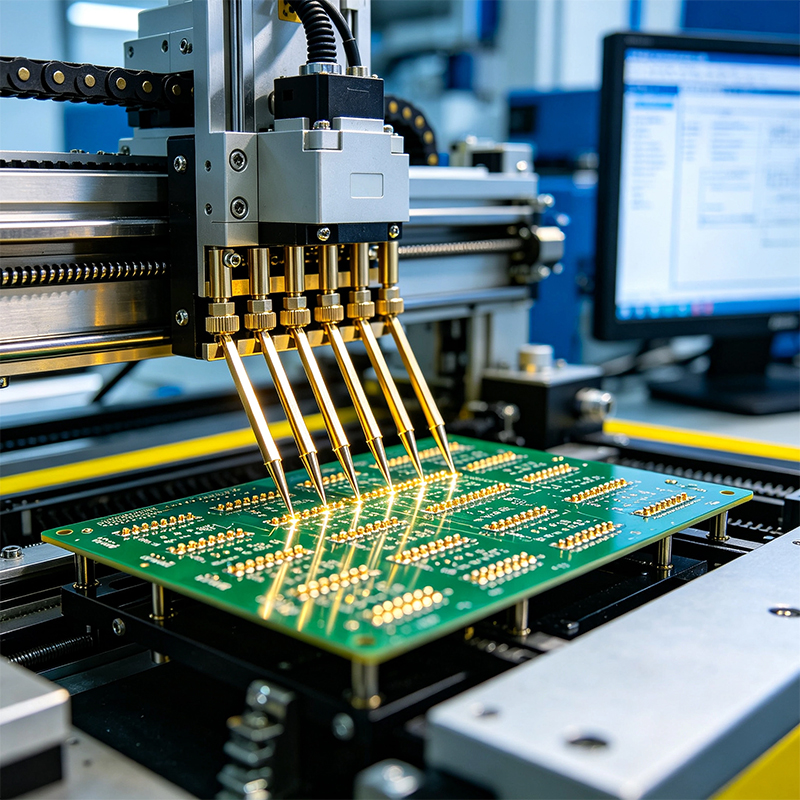
5. In-Circuit Test (ICT)
ICT uses a bed-of-nails fixture — hundreds or thousands of spring-loaded probes on a fixture that contacts all test points simultaneously [9†L12-L15].
ICT is extremely fast — seconds per board — and highly accurate, testing opens, shorts, resistance, capacitance, and diode polarity [9†L13-L15].
ICT is ideal for high-volume production. But fixtures are expensive — thousands to tens of thousands of dollars — and if your board design changes, the fixture may become scrap [10†L37-L41].
6. Functional Test (FCT)
The earlier tests check components and connections. Functional test is different — it simulates the product's real operating environment, applying power, signals, and loads to verify the board works as it would in the field [8†L40-L42].
FCT is typically used during R&D and final inspection before shipping.
This is the most common question manufacturers ask. The choice comes down to volume and budget:
| Feature | Flying Probe (FPT) | ICT |
|---|---|---|
| Fixture cost | None | High (thousands to tens of thousands) |
| Test speed | Slow (minutes/board) | Very fast (seconds/board) |
| Flexibility | Very high (change program only) | Low (design change = new fixture) |
| Best for | Prototypes, small batches, high-mix | High-volume production |
Simply put: prototypes and low volume → flying probe; high volume → ICT [9†L45-L46][2†L19-L21].
If your product uses flex PCBs or rigid-flex boards, testing is significantly more complex than rigid board testing. Flex board testing isn't just a scaled-down version of rigid board testing — it has its own unique challenges [5†L6-L7][13†L32-L33].
1. Mechanical Stress During Testing
Standard test fixtures clamp rigid boards firmly — but clamping a flex board the same way can crack the flexible substrate or weaken solder joints [13†L35-L37]. Flex boards also vibrate or shift during testing, making consistent probe contact difficult [5†L36-L38].
2. Solder Joint Fatigue
Solder joints on flexible sections are prone to fatigue from bending. A joint that looks fine under static testing might fail after repeated flexing — making dynamic bend testing essential [13†L38-L40]. IPC standards like IPC-2223 and IPC-9204 define testing frameworks for flex boards [11†L7-L10].
3. Specialized Fixtures Required
Flex and rigid-flex boards require custom carriers or handling fixtures to provide support during testing [5†L37-L38]. A standard rigid-only shop won't have this capability.
This is why flex and rigid-flex testing requires an experienced manufacturer.
PCB testing is governed by a complete IPC standards framework:
IPC-A-600: Visual acceptance criteria for bare boards [3†L47-L52][11†L49-L50]
IPC-6012: Performance and testing requirements for rigid boards [3†L11-L14][3†L41-L43]
IPC-6013: Performance and testing requirements for flex boards [11†L23-L25]
IPC-9257: Electrical testing procedures [11†L32]
IPC-TM-650: Over 150 test methods — mechanical, chemical, electrical, environmental [3†L27-L29][6†L4-L6]
IPC-9711/9712: Standards for AOI and automated inspection systems [3†L18-L20]
We are not a standard rigid-only PCB shop. We are a one-stop manufacturer that designs and makes flexible PCBs, rigid-flex boards, HDI high-frequency boards, and then does full PCBA. PCB testing is a mandatory step for every board we ship.
Full testing capability: SPI, AOI, X-Ray, flying probe, ICT, FCT — from paste printing to final assembly, every stage is inspected.
Flex/rigid-flex testing expertise: Custom test fixtures and carriers for flex and rigid-flex boards — we know how to test without damaging the substrate.
IPC-compliant: Fabrication and testing to IPC-A-600, IPC-6012, IPC-6013, IPC-9257, and more.
Traceable test data: Every board's test results are recorded for full quality traceability.
Free DFM review: Send your design files, get a DFM report within 24 hours — including test point accessibility assessment.
Projects we've served: consumer electronics, industrial controls, automotive, medical devices, communications — every board goes through a complete test process before shipping.
If you have PCB or PCBA testing needs, it's three simple steps:
Send your files: Gerbers, BOM, and any test requirements.
We review and quote: Within 24 hours, you'll receive a test plan and pricing.
Test and report: We run the tests and provide a complete test report.
PCB testing isn't an "extra cost" — it's "quality insurance." Catching a bad board at the factory costs one board. Finding a bad board in the field costs returns, rework, compensation, and lost customers.
The global PCB testing services market has already surpassed $4.2 billion and is growing at over 6% annually [7†L11-L13]. That tells you the industry's consensus: untested products aren't worth shipping.
If you're looking for a PCBA partner that understands testing — especially flex and rigid-flex board testing — send us your requirements. We won't push a contract — we'll first run a free test plan assessment and let our expertise speak.
When you contact us, please include:
Product type and application
Whether it uses flex or rigid-flex boards
Estimated annual quantity (samples, small batch, or mass production)
We'll give you an honest answer — what we can do, what we can't, and how to modify your design to make it testable.

Kaboer manufacturing PCBs since 2009. Professional technology and high-precision Printed Circuit Boards involved in Medical, IOT, UAV, Aviation, Automotive, Aerospace, Industrial Control, Artificial Intelligence, Consumer Electronics etc..


 English



 Wechat
 +86 13670210335
 +86 13670210335
 E-mail