
Date: 2026-07-13
You’ve definitely seen them before. Those small brown or black rectangular blocks on a circuit board, with colorful stripes or tiny numbers printed on them. They’re everywhere, but they don’t look like much. They’re called resistors.
Resistors are the most basic, most common, and most “low-key” components in electronics. They’re not as smart as chips, not as flashy as LEDs, but if they’re missing, the whole circuit can fail instantly. In this guide, I’ll explain what resistors do in a circuit, how they work, and why almost every circuit board has them. Plain English, no fluff.
A resistor’s job is simple — it restricts the flow of electric current.
Think of it as a traffic cop or a speed bump in a circuit. Current flows from the power source like cars on a highway. The resistor is a speed bump that slows down traffic — not stopping it, but controlling how much gets through.
Why does a resistor restrict current? Because it’s made of materials that don’t conduct electricity well. When current flows through a resistor, electrons collide with atoms in the material — like walking through a crowded hallway. They move slower, and they generate heat. That’s exactly how a resistor turns electrical energy into heat.
The unit of resistance is the ohm (Ω) , and the symbol is R. Higher resistance = more restriction.
Resistors do a lot of different jobs. Here are the most important ones.
1. Limit Current — Protecting Components from Overload
This is the most basic and most common job of a resistor. Many electronic components — especially LEDs — are very sensitive to current. Too much current and they burn out instantly.
For example, a standard LED needs about 20mA (0.02 amps) at around 2V. If you connect it directly to a 5V power supply, the current will far exceed 20mA and the LED will burn out in a fraction of a second. Add a resistor in series — that’s a current-limiting resistor — and the LED stays safe.
2. Divide Voltage — Splitting Voltage into Different Levels
Different components in a circuit often need different voltages. When resistors are connected in series, the total voltage gets divided across them — higher voltage across higher resistance, lower voltage across lower resistance. This is called voltage division.
The volume knob on your stereo is really just a variable resistor (potentiometer) changing the voltage division — turning the knob changes the voltage reaching the amplifier, and the volume changes.
3. Bias Transistors — Making Them “Wake Up”
Transistors and many chips need a specific voltage at their control pin to turn on. Too high, and they burn. Too low, and they won’t work. Engineers use a few resistors to create a “voltage divider” that feeds the transistor’s base exactly the right voltage. This is called biasing — without these bias resistors, the transistor wouldn’t work at all.
4. Pull-Up and Pull-Down — Keeping Signals “Floating” Under Control
In digital circuits, a chip’s input pin needs a clear signal — either high (logic 1) or low (logic 0). If it’s left unconnected, it becomes “floating” — neither high nor low. That causes erratic behavior and random failures.
A pull-up resistor connects the pin to a high voltage (pulls it up). A pull-down resistor connects it to ground (pulls it down). Without them, the input pin is like a loose wire — it can pick up noise and cause the circuit to act randomly. A simple pull-up resistor can turn a flaky circuit into a rock-solid one.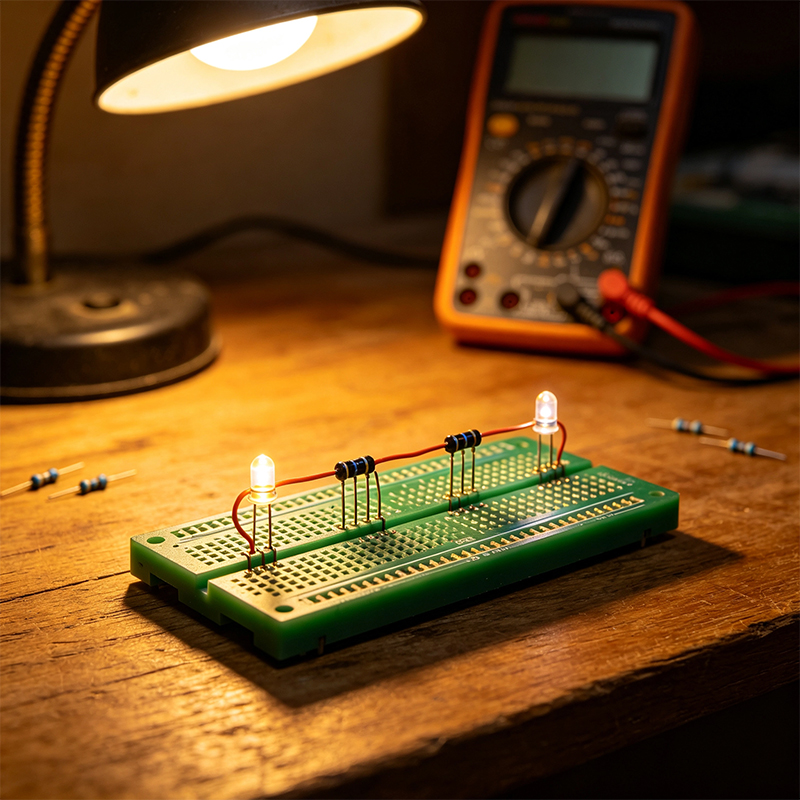
5. Work with Capacitors — Filtering and Timing
Resistors and capacitors often work together as an RC circuit.
When current flows through a resistor to charge a capacitor, the voltage doesn’t jump instantly — it rises gradually. That’s time delay. Many “power-on delay” or “reset delay” circuits are built with RC networks.
6. Feedback and Gain Control — Making Amplifiers Behave
In operational amplifiers (op-amps) and audio amplifiers, resistors set the amplification factor. Change the feedback resistor value, and the gain changes. That’s why volume controls and microphone preamp gain adjustments are essentially resistor adjustments.
7. Thermal Sensing — Detecting Temperature
Special resistors called thermistors change resistance with temperature. NTC (Negative Temperature Coefficient) thermistors drop resistance as temperature rises — they’re used for temperature sensing or inrush current limiting.
8. Current Sensing — Translating Current into Voltage
Some resistors have extremely low resistance (like 0.01Ω) and are called current-sense resistors (or shunts). When current flows through them, they produce a tiny voltage drop. Measure that voltage, calculate the current. They’re used in power management and battery protection circuits.
Resistor values are marked in two ways:
Color bands: 4 or 5 colored stripes — each color represents a digit or multiplier. You need a color code chart to read them.
Digit marking: Small surface-mount resistors have three-digit numbers like “103” — that means 10×10³ = 10kΩ. “472” means 47×10² = 4700Ω = 4.7kΩ.
Resistors are the traffic cops of electronics — they limit current, divide voltage, protect components, and stabilize signals.
Here’s where you’ll find them:
The resistor next to an LED: current limiting — protects the LED from burning out
Behind the volume knob: voltage division — controls the volume
The resistor connected to a chip’s input pin: pull-up — keeps the pin from floating
Inside a sensor module: filtering or thermal sensing
Resistors don’t light up, don’t compute, and don’t make noise. But they’re the most reliable, most essential infrastructure in any circuit. Without them, LEDs burn, chips glitch, signals float, and amplifiers run wild. So next time you see those unassuming little blocks on a circuit board — you’ll know they’re the traffic cops, quietly controlling every electron in the circuit.
If you’re designing an electronic product, choosing the right resistor value is one of the keys to making your circuit work reliably.

Kaboer manufacturing PCBs since 2009. Professional technology and high-precision Printed Circuit Boards involved in Medical, IOT, UAV, Aviation, Automotive, Aerospace, Industrial Control, Artificial Intelligence, Consumer Electronics etc..


 English



 Wechat
 +86 13670210335
 +86 13670210335
 E-mail