
Date: 2026-07-10
You've definitely seen the inside of a computer before. The motherboard isn't sitting flat against the metal case — it's raised up on a bunch of small metal posts. There's a gap between the board and the chassis, and screws go through the board into those posts. Those small posts are called circuit board standoffs.
A circuit board standoff (also called a PCB standoff, spacer, or pillar) is a small fastener that holds a circuit board at a fixed distance from another surface — like a chassis, another board, or a panel. It might not look like much, but without it, your device could short-circuit, overheat, or literally fall apart.
In this guide, I'll explain what circuit board standoffs are, why they matter, what types exist, how to choose the right one, and how to install them. Plain English, no fluff.
A circuit board standoff is simply a small post that's threaded on one or both ends (or has a snap-in clip). Its job is to raise, support, and secure a circuit board away from other surfaces.
Think of standoffs as the circuit board's "legs" — they lift the board up so the bottom doesn't touch anything conductive, and they let air flow underneath to cool things down. Without standoffs, the board would sit flat against the chassis — solder joints on the back would short against the metal, there'd be no airflow for cooling, and vibration would cause the board to flex and crack solder joints. A single loose screw can kill an entire board.
A lot of people use these terms interchangeably, but they're actually different.
A standoff is threaded — it has threads on both ends so you can screw it in and lock it down. It both spaces and secures.
A spacer is usually unthreaded — it's just a hollow tube that a bolt passes through. It only spaces, it doesn't lock.
Standoff = space + secure. Spacer = space only. If you need the board held tight against vibration, use a standoff. If you just need distance and don't need it super secure, a spacer is fine.
Standoffs are categorized by the "gender" of their threads:
1. Female-Female
Internal threads on both ends. Used when both sides have threaded holes or inserts. Common inside enclosures — the standoff screws into the chassis, and the board screws into the standoff.
2. Female-Male
One internal thread, one external thread. The most common and versatile type. One end screws into the chassis, the other end sticks out for the board to screw onto. This is what computer motherboards use.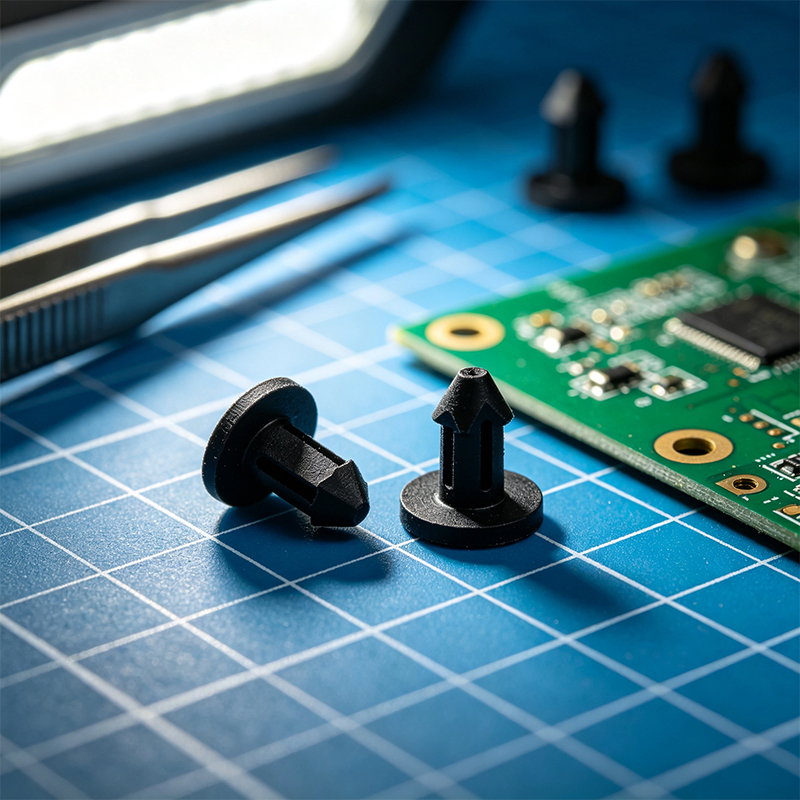
3. Male-Male
External threads on both ends. Acts like an "extension screw" — screw one end into a hole, and the other end gives you a new threaded post to mount things on.
Standoffs also come in round and hexagonal shapes. Hexagonal lets you use a wrench for more torque; round is for finger-tightening only.
The material determines conductivity, strength, and durability.
Nylon (Plastic) : Non-conductive, insulating. Lightweight, cheap, chemically resistant, but not load-bearing. Options include plain nylon, 25% glass-filled nylon (stronger), and PEEK (heat-resistant up to 185°C). Operating range typically -40°C to 85°C.
Brass : The most common metal. Conductive, corrosion-resistant, and easy to machine. Used when you need grounding — metal standoffs connect the board's ground plane to the chassis for EMI shielding. Usually nickel-plated to prevent oxidation.
Aluminum : Lightweight and thermally conductive. Great for weight-sensitive designs or applications needing heat dissipation. Similar strength to brass but lighter.
Stainless Steel : Strongest and most durable. Used in industrial, outdoor, or high-abuse environments. Heavier and more expensive than brass.
Rule of thumb: need insulation? → Nylon. Need grounding or heat transfer? → Brass or Aluminum. Need toughness? → Stainless Steel.
Two things to consider: thread size and length.
Common thread sizes:
Metric: M2, M2.5, M3, M4, M5. M3 is the most common.
Imperial: #4-40, #6-32, #8-32.
Length depends on how much spacing you need. Typical lengths range from 3mm to 25mm. Short (3-6mm) for compact electronics; long (10mm+) for stacked boards or tall heat sinks.
Installation is straightforward:
Mark and drill mounting holes in the chassis.
Screw the standoff into place — by hand or with a wrench.
Place the circuit board on top, aligning the holes.
Fasten screws through the board into the standoff.
Special mounting styles:
Press-fit: Pushed directly into a hole — no threads needed.
Adhesive: Sticks onto surfaces with double-sided tape — for lightweight boards or quick prototyping.
Snap-in: Plastic clips that snap into place by hand — no tools required.
A circuit board standoff is a small post that raises and secures a circuit board away from other surfaces. It prevents shorts, enables airflow for cooling, and protects the board from vibration. Standoffs are threaded (unlike spacers), come in female-female, female-male, and male-male types, and are made from nylon, brass, aluminum, or stainless steel. Installation can be threaded, press-fit, adhesive, or snap-in.

Kaboer manufacturing PCBs since 2009. Professional technology and high-precision Printed Circuit Boards involved in Medical, IOT, UAV, Aviation, Automotive, Aerospace, Industrial Control, Artificial Intelligence, Consumer Electronics etc..


 English



 Wechat
 +86 13670210335
 +86 13670210335
 E-mail