
Date: 2025-12-12
If you've ever opened up any electronic device—be it a smartphone, a laptop, or even a smart coffee maker—you've seen a green board studded with tiny silver components and fine copper traces. That seemingly ordinary board is actually the finished product of PCBA assembly. It's the beating heart that makes every electronic device come to life.
People often confuse PCB and PCBA. The difference is straightforward: a PCB is the bare green board with only the circuit traces. A PCBA is that same board after the full assembly process, populated with all the chips, capacitors, resistors, and other components, forming a functional electronic module.
Think of a PCB as a blank LEGO baseplate. The PCBA is the complete model after hundreds of LEGO bricks (electronic components) have been precisely snapped onto that baseplate according to an exact blueprint. That building process is PCBA assembly.
The PCBA assembly process is far more complex than it looks. It's a precise, meticulous industrial workflow, primarily consisting of two core technologies:
1. SMT (Surface Mount Technology)
This is the workhorse of modern electronics, handling flat, lead-less micro-components.
Step 1: Solder Paste Printing. Like screen-printing a T-shirt, a precise stencil is used to apply viscous solder paste onto the PCB's pads.
Step 2: Component Placement. A pick-and-place machine, moving at blinding speeds (tens of thousands of components per hour), uses nozzles to pick micro resistors, capacitors, and ICs from reels and place them accurately on the paste. It's a supremely precise robotic pickup game.
Step 3: Reflow Soldering. The populated PCB travels through a reflow oven—a precise, conveyorized oven. A carefully controlled temperature profile melts the solder paste, allowing it to flow and form a joint before cooling and solidifying, permanently bonding the components.
2. THT (Through-Hole Technology)
For components that need to withstand greater mechanical stress or higher current (like large connectors, transformers), this traditional yet robust process is still used.
Component leads are inserted into drilled holes on the PCB, either manually or by automated machines.
The board's underside then passes over a wave of molten solder in a wave soldering machine, creating solid solder joints.
A complex product often requires a mix of SMT and THT. After soldering, post-assembly steps like cleaning, programming, and functional testing are conducted before a fully functional PCBA is born.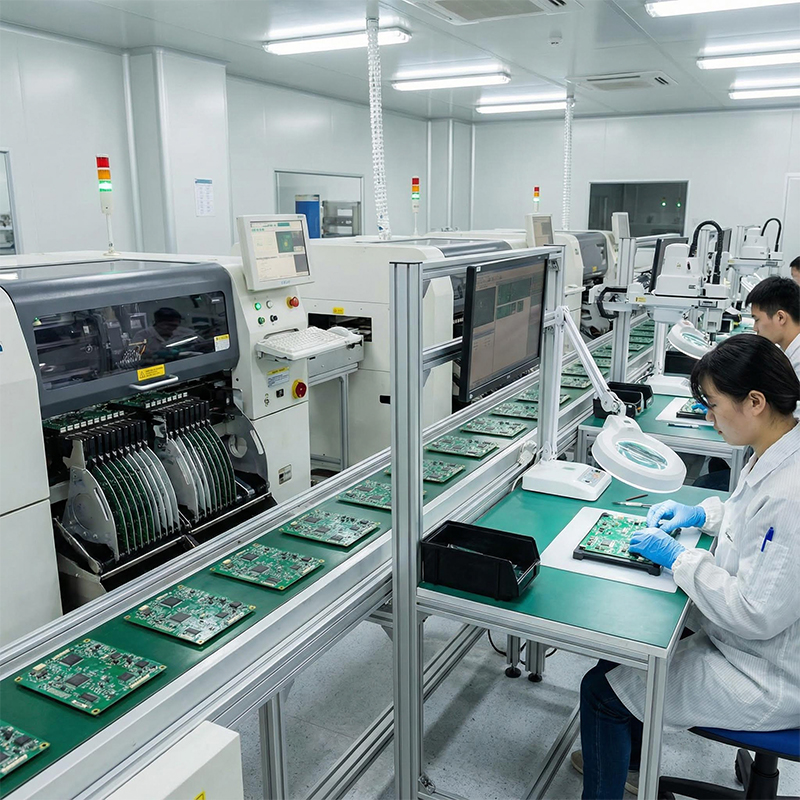
Nearly every "smart" or powered device you interact with daily relies on a PCBA at its core. Requirements vary drastically by field:
Consumer Electronics: The most visible market—your phones, computers, TVs, gaming consoles, and smart home gadgets. These PCBs chase extreme miniaturization, high performance, and cost-efficiency, often utilizing advanced HDI boards and fine-pitch SMT.
Industrial & Automation: PLC controllers, machine vision systems, motor drives in factories. The mantra here is extreme reliability and ruggedness to withstand harsh environments (wide temperature swings, vibration, dust). These often demand thicker copper, industrial-grade components, and enhanced conformal coating.
Automotive Electronics: A modern car is a supercomputer on wheels. From engine control units to infotainment to ADAS, a single vehicle contains over a hundred PCBAs. They must pass stringent automotive-grade certifications to perform flawlessly between -40°C and 125°C with intense vibration. This demands top-tier process control and consistency.
Medical Devices: As mentioned before, this is a "zero-defect" field. PCBAs in medical devices, from portable monitors to imaging systems, are critical to life. Manufacturing requires cleanroom conditions, strict traceability, and rigorous testing.
Telecom & Data Centers: 5G base stations, routers, servers. These PCBAs handle high-speed signals, placing a premium on signal integrity, thermal management, and power integrity, often involving complex multilayer boards and special materials.
Many companies fall into the "lowest bid wins" trap when sourcing PCBA. Behind a quote lie critical factors that determine a project's success or failure:
1. Design Translation: From Files to a Productible Design
A perfect design on screen can be unmanufacturable or have low yield. A skilled PCBA partner performs a Design for Manufacturability review before production, flagging issues like insufficient component clearance or poor test access, saving clients from massive late-stage rework and cost overruns.
2. Supply Chain Depth and Resilience
The electronics industry faces frequent component shortages. A strong partner uses its purchasing network and scale to secure key parts for you, offer alternative component solutions, and keep your production line running—a capability small shops lack.
3. Quality is "Built," Not Just "Inspected"
Quality isn't achieved by final inspection alone but through full-process control. This means real-time monitoring of critical parameters: solder paste deposition, oven temperature profiles, placement accuracy. Consistency and reliability come from keeping these processes within their optimal windows.
4. Comprehensiveness of Testing
Testing is the final firewall ensuring you receive a working product. Basic flying probe test checks connections, but functional testing, boundary scan, and burn-in simulate real-world operation. The depth of testing directly impacts early failure rates in the field.
At Kaboer, we view PCBA assembly as a systems engineering challenge. We aim to be an extension of our clients' R&D and manufacturing teams, helping turn innovative ideas into market-ready products swiftly, reliably, and cost-effectively.
Our Core Value Proposition:
Turnkey Solution, Simplified Management: We provide an end-to-end service from PCB fabrication, component sourcing & kitting, SMT/THT assembly, testing, to box-build assembly. You manage one partner instead of multiple vendors, drastically reducing complexity and accelerating time-to-market.
DFX Expertise: Our engineering team brings cross-industry experience to the table. By engaging early in your design phase, we provide actionable feedback on Manufacturability, Testability, and Cost, enhancing product reliability and production efficiency from the start.
Transparent & Flexible Collaboration: Whether you need fast-turn, low-volume prototyping for design validation or a seamless transition to high-volume production, we have a model to match. Our transparent project management portal keeps you informed at every step.
Reliability by Discipline: We invest in advanced equipment and robust systems. From Statistical Process Control to automated production lines, we ensure every PCBA meets the promised standard. For automotive, medical, and other demanding fields, we adhere to the relevant industry benchmarks.
Choosing a PCBA assembly partner is fundamentally a choice about your product's quality, time-to-market, and total cost of ownership. At Kaboer, we believe that excellence in manufacturing is not a cost center but a core competitive advantage for our clients.
If you're looking for a reliable, efficient manufacturing partner who truly understands your needs for your next electronics project, let's talk. Together, we can turn great ideas into tangible reality.

Kaboer manufacturing PCBs since 2009. Professional technology and high-precision Printed Circuit Boards involved in Medical, IOT, UAV, Aviation, Automotive, Aerospace, Industrial Control, Artificial Intelligence, Consumer Electronics etc..


 English



 Wechat
 +86 13670210335
 +86 13670210335
 E-mail