
Date: 2026-03-24
If you've ever looked at a modern circuit board, you've seen them. Those tiny black rectangles with numbers printed on them. They're everywhere—hundreds of them on a single smartphone board, dozens on a simple power supply. They're SMD resistors, and they're the unsung workhorses of electronics.
Most people don't think much about resistors. They're just... there. But here's the thing: get your resistor selection wrong, and your circuit doesn't just stop working—it can overheat, drift out of spec, or fail entirely. And with surface-mount devices getting smaller every year, choosing the right one matters more than ever.
Let's talk about what SMD resistors actually are, how to read them, what the numbers mean, and how to pick the right one for your board.
An SMD resistor (Surface Mount Device resistor) is a tiny electronic component that limits the flow of electric current . It's the passive component you'll see more than any other on a typical PCB. Its job is simple: resist current. That's it. But that simple function makes it essential for everything from LED current limiting to voltage division, pull-ups, pull-downs, and signal conditioning .
Unlike old-school through-hole resistors with wire leads, SMD resistors sit flat on the board and solder directly to pads on the surface. They're small, they're cheap, and they come in standardized sizes that your pick-and-place machine can handle by the thousands.
If you've ever ordered resistors, you've seen codes like 0402, 0603, 0805. Those numbers tell you the physical size in inches.
| Code | Dimensions (mm) | Dimensions (inches) | Common Use |
|---|---|---|---|
| 0201 | 0.6 × 0.3 | 0.02 × 0.01 | Ultra-compact, RF, smartphones |
| 0402 | 1.0 × 0.5 | 0.04 × 0.02 | High-density, common in mobile |
| 0603 | 1.6 × 0.8 | 0.06 × 0.03 | General-purpose workhorse |
| 0805 | 2.0 × 1.25 | 0.08 × 0.05 | Easier to handle, good for prototyping |
| 1206 | 3.2 × 1.6 | 0.12 × 0.06 | Higher power, easier to inspect |
| 2010 | 5.0 × 2.5 | 0.20 × 0.10 | Power applications |
| 2512 | 6.4 × 3.2 | 0.25 × 0.12 | High power (up to 1W or more) |
The trade-off is straightforward: smaller resistors save board space but are harder to handle, harder to inspect, and have lower power ratings. Larger resistors are easier to work with and handle more power, but they take up more real estate.
For most general-purpose designs, 0603 is the sweet spot. It's small enough for density but large enough to handle by hand if needed. For mass production where space is critical, 0402 is common. For power circuits, you'll see 0805 and up.
Here's where people get tripped up. Unlike through-hole resistors with colored bands, SMD resistors have printed numbers. But those numbers aren't always the value.
This is the most common system. The first two digits are the significant figures. The third digit is the multiplier—how many zeros to add.
102 = 10 × 10² = 10 × 100 = 1000Ω = 1kΩ
471 = 47 × 10¹ = 47 × 10 = 470Ω
223 = 22 × 10³ = 22 × 1000 = 22kΩ
100 = 10 × 10⁰ = 10 × 1 = 10Ω (not 100Ω!)
The last digit is the number of zeros. So 102 is "10" with two zeros = 1000. 223 is "22" with three zeros = 22000.
For higher precision resistors (1% or better), you'll see four digits. The first three are significant figures, the fourth is the multiplier.
1002 = 100 × 10² = 100 × 100 = 10,000Ω = 10kΩ
4701 = 470 × 10¹ = 470 × 10 = 4,700Ω = 4.7kΩ
1000 = 100 × 10⁰ = 100 × 1 = 100Ω
For values under 10 ohms, the letter "R" acts as a decimal point.
4R7 = 4.7Ω
R22 = 0.22Ω
1R0 = 1.0Ω
For very small packages (0402 and below), there's often not enough room for four digits. The industry uses a two-character code called EIA-96. A lookup table tells you what value each code represents. Common examples:
01A = 100Ω
02A = 102Ω
03A = 105Ω
If you encounter these, the easiest approach is to check a chart or just measure with a multimeter.
Here's something that catches people off guard: the power rating of an SMD resistor is directly tied to its size.
| Package | Typical Power Rating |
|---|---|
| 0201 | 1/20W (0.05W) |
| 0402 | 1/16W (0.0625W) |
| 0603 | 1/10W (0.1W) |
| 0805 | 1/8W (0.125W) |
| 1206 | 1/4W (0.25W) |
| 2010 | 3/4W (0.75W) |
| 2512 | 1W |
If you're designing a circuit that needs to dissipate heat, you can't just grab an 0402 and hope for the best. The resistor will overheat, drift out of spec, and eventually fail. Always check your power calculations before picking a package.
For LED current limiting, a 1206 or 0805 is often a safe bet. For signal lines where power is negligible, 0402 or 0603 works fine.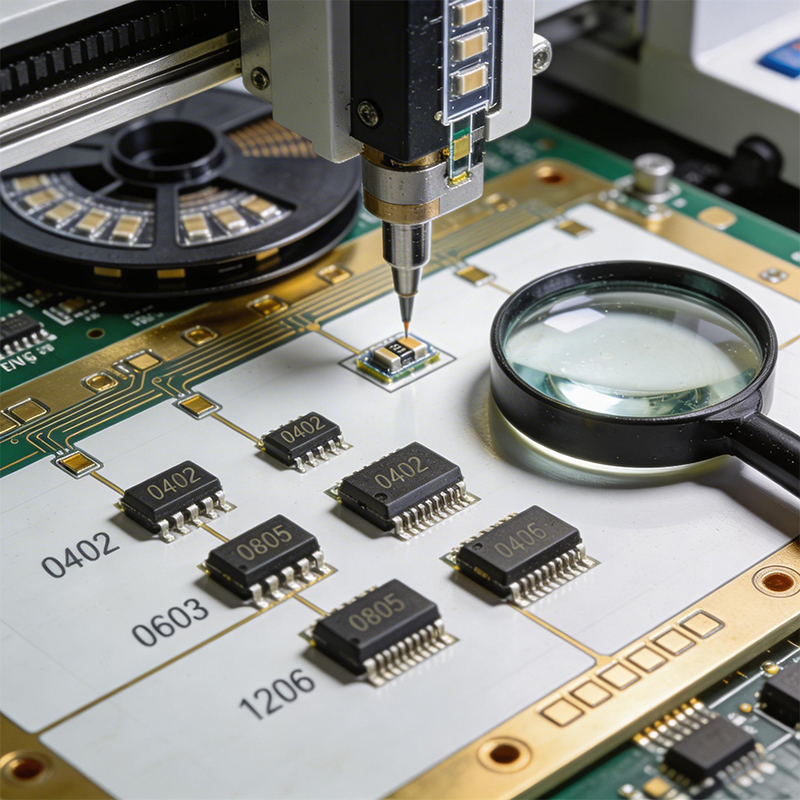
Resistor tolerance tells you how close the actual resistance will be to the marked value.
5% (J) : The most common. Fine for LED current limiting, pull-ups, general-purpose circuits.
1% (F) : Used when you need tighter accuracy—voltage dividers, analog circuits, precision references.
0.5%, 0.1% (D, B) : For measurement circuits, instrumentation, and high-precision applications. More expensive, but sometimes necessary.
For most consumer electronics, 5% is fine. For anything involving analog measurements or timing, 1% is safer.
You design with 0603 resistors but the circuit draws more current than they can handle. Result: overheating, drift, eventual failure.
Prevention: Calculate power dissipation. P = I²R. If you're dropping 5V across 100Ω with 50mA, that's 0.25W. You need at least a 1206. Don't guess.
During reflow, a small resistor stands up on one end. Usually caused by uneven heating or uneven pad design.
Prevention: Use symmetrical pad layouts. Ensure both pads have similar thermal mass. If one pad connects to a large copper pour and the other doesn't, the side with less copper will heat faster and pull the component upright.
0201 and 0402 resistors are tiny. If your stencil design isn't right, you'll get insufficient solder or bridges.
Prevention: Follow the manufacturer's recommended footprint. Use proper stencil aperture design. For prototypes, consider using 0603 instead—they're easier to work with.
You spec a 100Ω resistor but the code "100" gets interpreted as 10Ω.
Prevention: Double-check your BOM against the manufacturer's datasheet. For prototypes, measure a few resistors before assembly.
When you're picking resistors for your design, run through this:
Resistance value: What does the circuit need?
Power rating: How much heat will it dissipate? P = I²R or P = V²/R.
Package size: Does your board have space? Is your assembly line set up for this size?
Tolerance: Is 5% good enough, or do you need 1%?
Temperature coefficient: Will the resistor value drift with temperature? For precision circuits, you need a low TCR.
Voltage rating: For high-voltage applications, check the maximum working voltage.
Availability: Is the part in stock? Are there alternatives?
At Kaboer, we've been building custom PCBs since 2009. Based in Shenzhen with our own PCBA factory, we see SMD resistors go onto boards every day. We know what works and what doesn't.
What we do:
BOM review: We check your resistor choices against your circuit requirements. If we see a power rating that's too low or a package that's too small for your assembly line, we flag it.
Footprint verification: We verify that your resistor footprints match the actual components. A mismatch between a 0603 footprint and an 0805 part is a recipe for assembly problems.
Placement optimization: We can suggest placement strategies to minimize tombstoning risk—like adding thermal relief to pads connected to large copper planes.
Fast prototyping: Need to test your resistor selection quickly? We can assemble prototypes in days, so you can validate your design before committing to volume.
We work across the full range of boards—rigid, flexible, rigid-flex, HDI—and we understand that resistor selection changes with the board type. A flex circuit might need smaller resistors to fit tight bend radii. A high-frequency board might need resistors with lower parasitic capacitance.
If you're designing a board and want to make sure your SMD resistors are right—or if you need help with resistor selection—send us your requirements or Gerber files. We'll review your design, give you honest feedback, and get back to you with a quote. We've been at this for over 15 years, and we believe the best partnerships start with straightforward conversations.
And if you're ever in Shenzhen, we'd be happy to show you around our factory and walk you through how we handle these tiny components.

Kaboer manufacturing PCBs since 2009. Professional technology and high-precision Printed Circuit Boards involved in Medical, IOT, UAV, Aviation, Automotive, Aerospace, Industrial Control, Artificial Intelligence, Consumer Electronics etc..


 English



 Wechat
 +86 13670210335
 +86 13670210335
 E-mail