
Date: 2026-03-16
Let’s be real for a second. If you’re in the business of making electronic products, you can’t escape SMT surface mounting technology. It’s the engine under the hood of every smartphone, smartwatch, and high-speed gadget on the market.
But if you ask a lot of people what it actually involves, you usually get vague answers about "tiny components and hot ovens." The truth is, understanding the nuts and bolts of SMT is the difference between a product that scales beautifully and one that bleeds cash on rework.
I’ve spent years in this industry, and I’ve seen the same mistakes happen when manufacturers don’t respect the process. Let’s cut through the jargon and talk about what SMT really means for your business.
SMT surface mounting technology is basically the method of soldering components directly onto the surface of a circuit board. Unlike the old-school way (Through-Hole Technology) where you push leads through holes and solder them on the other side, SMT components just sit on top .
Think of it like the difference between gluing something onto a wall versus nailing it through to the other side. It’s faster, takes up way less space, and lets you use both sides of the board. That’s how your phone stays thin even though it has more computing power than a 90s supercomputer.
It wasn’t just a random industry whim. SMT wins for three simple reasons: speed, space, and signal integrity.
1. Size and Density
SMT components are tiny. We’re talking 0402 (1.0mm x 0.5mm) packages as a standard. Because they don't have long leads, you can pack hundreds more components into the same area. If you tried to build a modern graphics card with through-hole parts, it would be the size of a refrigerator.
2. High-Frequency Performance
This is the one engineers really care about. Those short little metal ends on SMT parts? They create almost no parasitic inductance compared to the long leads of through-hole components. For anything running at GHz speeds—think 5G, Wi-Fi 6, or high-speed data converters—SMT isn’t just better; it’s mandatory.
3. Automation and Cost
Pick-and-place machines are marvels of engineering. They can place tens of thousands of components per hour with surgical precision. This level of automation means your cost per board drops drastically once you hit medium-to-high volumes. Hand-soldering through-hole boards just doesn't scale.
If you ever get a chance to walk through a modern assembly line, here’s what you’ll see happening in stages:
The Stencil & Paste: It starts with a stainless steel stencil. Think of it like a very precise screen printer for your PCBs. It deposits a grayish paste (solder paste) exactly where components need to go. Get this step wrong, and nothing else matters.
The Pick-and-Place (The Coolest Part): High-speed machines with tiny vacuum nozzles pick components from reels and place them onto the paste. They’re accurate to within a few tens of microns. Watching them place a hundred tiny resistors in seconds is genuinely impressive.
The Reflow Oven: The board slides into a long tunnel with controlled heat zones. The paste melts, flows, and forms a permanent electrical and mechanical connection as it cools. It’s like a very sophisticated pizza oven for electronics.
Inspection: After that, machines check the work. Automated Optical Inspection (AOI) looks for obvious flaws, and X-ray machines peek underneath chips like BGAs where you can’t see the joints.
Even with all this automation, things can go sideways. Here are a couple of classic headaches:
Tombstoning: That’s when a tiny resistor or capacitor stands up on one end, looking like a grave marker. It happens when one end of the part heats up faster than the other. The fix is usually in the pad design or the reflow profile.
Solder Bridging: This is when solder forms an unintended connection between two pins, causing a short. It often comes down to too much paste or pads that are too close together.
Voids: These are hidden air pockets inside the solder joint, especially common under large chips like BGAs. You usually need an X-ray to see them. They’re caused by outgassing during reflow.
The best way to avoid this? Work with a shop that actually checks these things.
At Kaboer, we’ve been running SMT lines since 2009. We’re based in Shenzhen, and we handle the full spectrum—from simple rigid boards to complex flexible circuits, rigid-flex, and HDI boards.
Here’s what that means for you:
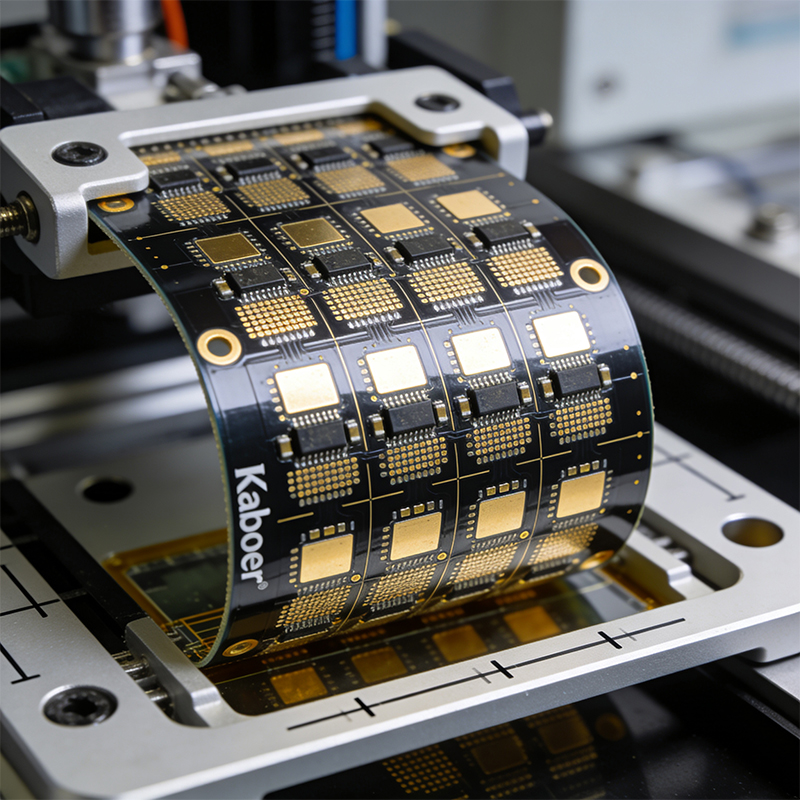
We work with what you’ve got. Whether your design uses standard FR-4 or needs the bendability of a flexible circuit, our SMT lines are set up to handle it. We use specialized carriers to keep flexible PCBs stable during printing, so you don’t get misalignment.
We check before we build. Before a single part is placed, our engineers run a thorough design review. We’ll spot potential tombstoning risks or paste issues in the digital stage, not after you’ve paid for a batch of bad boards.
We can prototype fast. Need to validate a design? We offer quick-turn assembly. Getting boards in days instead of weeks helps you catch issues early, when they’re cheap to fix.
We do it all in-house. Because we fabricate our own PCBs and assemble them, you’ve got one throat to choke. No finger-pointing between the board maker and the assembly house.
We also hold ISO 9001, IATF 16949 (for automotive), and ISO 13485 (for medical) certifications. Our processes aren’t just haphazard; they’re documented and repeatable.
SMT surface mounting technology is the workhorse of the electronics industry. It’s what allows us to build complex, powerful, and portable devices. But like any workhorse, it needs to be treated right.
If you're looking for a partner who actually understands the nuances—who knows that a flexible board needs different handling than a rigid one, and who checks their work at every stage—let’s talk.
Send us your requirements. We’ll get back to you with a free quote and some honest technical feedback within 2 hours.
And if you’re ever in Shenzhen, come visit the factory. See the machines in action, meet the team, and ask all the questions you want.

Kaboer manufacturing PCBs since 2009. Professional technology and high-precision Printed Circuit Boards involved in Medical, IOT, UAV, Aviation, Automotive, Aerospace, Industrial Control, Artificial Intelligence, Consumer Electronics etc..


 English



 Wechat
 +86 13670210335
 +86 13670210335
 E-mail