
Date: 2026-03-16
Let's be honest—if you're in the business of making electronic products, you've heard the term surface mount device more times than you can count. It's one of those industry basics that everyone assumes you just know. But when you really stop and think about it, what actually is an SMD? And more importantly, why should you care?
I remember talking to a procurement manager last year who'd been ordering boards for five years but couldn't tell me the difference between an SMD and a through-hole part. And honestly? That's more common than you'd think. The jargon gets thrown around so much that the fundamentals get lost.
So let's cut through the noise. Whether you're sourcing components, designing boards, or just trying to make sense of your supplier's BOM, here's what you actually need to know about surface mount devices.
A surface mount device (or SMD) is exactly what it sounds like—an electronic component designed to be mounted directly onto the surface of a printed circuit board . No leads poking through holes. No soldering on the other side. Just sits flat on the board and gets soldered right where it lands.
This is different from the older way of doing things—through-hole technology—where components had long wire leads that you'd push through drilled holes and solder on the opposite side . Think of through-hole like nailing something through a board; SMD is like sticking a magnet on a fridge. It stays put, takes up less space, and you can put stuff on both sides.
SMDs come in all shapes and sizes: tiny resistors and capacitors, complex microchips, LEDs, transistors—pretty much anything you'd find on a modern circuit board . They're the reason your phone can be thinner than a pencil and still do more than a 90s supercomputer.
If you're trying to decide which way to go with your designs, here's the honest breakdown of how these two stack up :
| What Matters | Surface Mount Devices (SMD) | Through-Hole Components |
|---|---|---|
| Size | Tiny, compact | Big, bulky |
| How they mount | Sit on the board surface | Leads go through drilled holes |
| Board space | Saves space, can use both sides | Eats up space, needs holes |
| Assembly speed | Fast, fully automated | Slower, more manual work |
| Cost at scale | Cheap when volume is high | More expensive for big runs |
| Mechanical strength | OK for normal use, needs care | Tough, handles abuse well |
| Fixing/rework | Tricky, needs hot air | Easy, regular iron works |
| High-speed signals | Excellent, short leads | Not great, long leads cause issues |
| Best for | Phones, computers, compact gear | Connectors, power parts, rugged stuff |
The way I see it, SMDs win for most modern electronics. They're smaller, faster to assemble, and actually perform better at high frequencies because those short connections mean less parasitic inductance . But through-hole isn't dead—connectors and power components still need that mechanical strength .
Surface mount devices split into two big families: active and passive .
These are the components that do the thinking and switching. They need power to work and actually process signals. You're looking at :
Integrated circuits (ICs) – Microcontrollers, memory chips, processors. These are the brains.
Transistors – Switching and amplification workhorses.
Diodes – Letting current flow one way only.
Active SMDs come in various packages: SOIC, QFP, QFN, BGA—the list goes on. Each has its own pros and cons for size, heat dissipation, and how easy they are to solder .
These don't need power and can't amplify anything, but circuits wouldn't work without them :
Resistors – Control current flow. You'll see codes like 0603, 0805—those are the package sizes .
Capacitors – Store and release energy. Ceramic ones are everywhere in high-frequency circuits .
Inductors – Filter and store energy in magnetic fields.
Passive SMDs are tiny. Like, really tiny. A 0402 package is 1.0mm by 0.5mm. An 0201 is half that. And yes, people use them every day .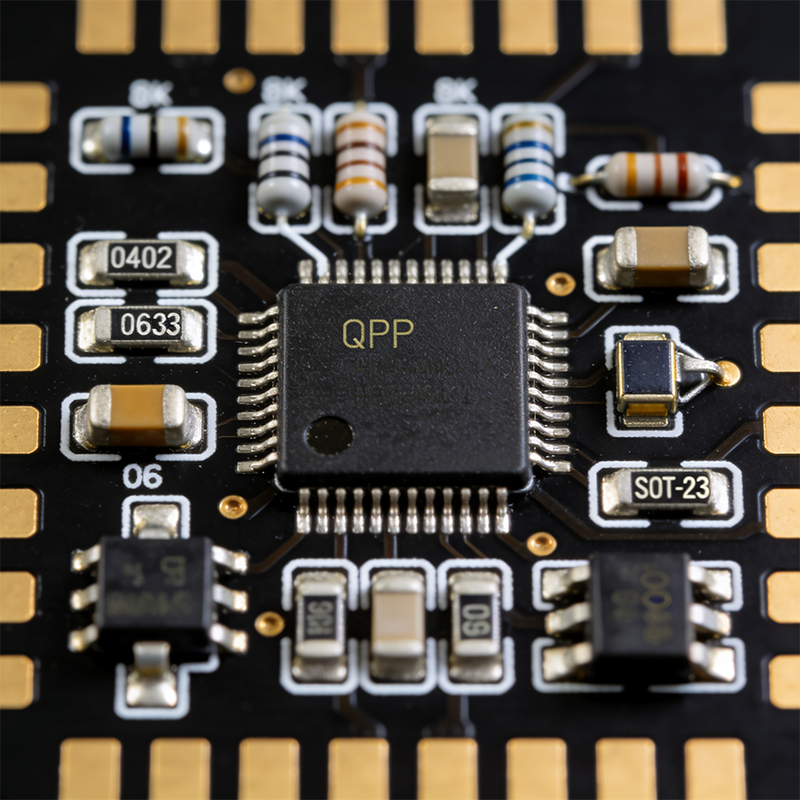
Here's where experience matters. I've seen designers choose components that looked great on paper but turned into assembly nightmares. A few things to think about:
Space constraints. If your board is cramped—wearables, medical gadgets, consumer stuff—you need small packages. 0402 or 0603 are common workhorses . For ultra-dense designs, people go down to 0201 or even 01005. But remember: smaller means harder to handle and inspect.
Power and heat. Tiny resistors can't handle much power. If you're pushing current through something, you need larger packages like 1206 or even special power SMDs with thermal pads . High-power LEDs and voltage regulators need to get rid of heat, so package choice matters.
Signal speed. For high-frequency stuff—5G, high-speed data, RF—you want SMDs every time. Those short connections mean lower parasitic capacitance and better signal integrity . Through-hole parts act like little antennas at high frequencies. Not good.
Assembly capability. Not every factory can place 01005 parts reliably. If you're working with a contract manufacturer, ask about their capability before you design in ultra-fine pitch BGAs or tiny passives.
The process of putting SMDs onto boards is called SMT—Surface Mount Technology. Here's the quick rundown of what happens :
Solder paste printing – A stainless steel stencil deposits solder paste exactly where components will go.
Pick and place – High-speed machines pick components from reels and put them on the paste, accurate to within microns.
Reflow soldering – The board goes through an oven with carefully controlled temperatures. The paste melts, flows, and forms solid connections.
Inspection – AOI (automated optical inspection) checks for visible defects. X-ray looks at hidden joints underneath chips like BGAs.
The whole thing is fully automated. Modern lines place tens of thousands of components per hour with fewer defects than any human could manage .
Here's the thing: understanding SMDs isn't just technical trivia. It affects your bottom line.
If you choose the right components, your boards work better, cost less to assemble, and actually fit in their enclosures. If you get it wrong, you're looking at rework, delayed schedules, and unhappy customers.
This is where working with a manufacturer who actually understands SMDs makes a huge difference. At Kaboer, we've been placing surface mount devices since 2009. We're in Shenzhen, running our own PCBA factory, and we handle the whole range—from tiny 0201 passives to complex BGAs, on flexible circuits, rigid-flex boards, HDI high-frequency boards, and everything in between.
What sets us apart? We don't just take orders. Our engineers actually look at your BOM, check footprints, and flag potential issues before they become expensive problems. We offer fast prototyping so you can validate your designs quickly. And if you're ever in Shenzhen, you're welcome to visit our factory and see how we work.
Look, picking the right surface mount devices isn't rocket science. But it does take experience and attention to detail. If you're working on a project and want to make sure you've got the right components for the job, let's talk.
Send us your requirements or BOM. We'll take a look, give you honest feedback, and get back to you with a quote as soon as we can. No pressure, no hard sell—just straight talk from people who've been doing this for over 15 years.
And if you're ever in Shenzhen, come visit. See how we build boards, meet the team, ask whatever you want. We're an open book.

Kaboer manufacturing PCBs since 2009. Professional technology and high-precision Printed Circuit Boards involved in Medical, IOT, UAV, Aviation, Automotive, Aerospace, Industrial Control, Artificial Intelligence, Consumer Electronics etc..


 English



 Wechat
 +86 13670210335
 +86 13670210335
 E-mail