
Date: 2026-07-08
You've definitely seen solder before — that silver wire on a spool, or those shiny little bumps on a circuit board. Whether it's hand soldering or automated assembly, solder is one of the most basic and essential materials in electronics manufacturing.
Solder is a metal alloy used to permanently join two metal parts together. Its melting point is lower than the metals being joined — when heated, it melts and wets the metal surfaces, then solidifies to form a strong electrical and mechanical connection.
In this guide, I'll explain what solder is, what types exist, why lead-free solder replaced leaded solder, and what forms solder comes in. Plain English, no fluff.
Solder is essentially a low-melting-point alloy. The principle is simple: it melts when heated and solidifies when cooled. Heat the two metal parts you want to join, let the molten solder "wet" the surfaces between them, and when it cools, they're joined.
The difference between solder and glue is that glue is physical adhesion — solder is a metallurgical bond. Solder forms an intermetallic compound with the base metal — they literally "grow together." That's why solder joints are much stronger than glued joints, and they conduct electricity too.
When it comes to solder, you can't avoid leaded solder. The classic formula is 63% tin + 37% lead — 63/37 solder. It's a eutectic alloy — it melts at exactly 183°C and goes straight from solid to liquid with no "mushy" in-between state.
Leaded solder has clear advantages: low melting point (183°C), excellent wetting, shiny joints, easy to work with, and cheap.
But it has one fatal flaw — it contains lead. Lead is toxic, and when electronics are discarded, lead leaches into soil and groundwater. In 2006, the EU introduced the RoHS Directive, restricting lead in electronic products. Since then, consumer electronics have shifted entirely to lead-free solder.
But leaded solder hasn't disappeared. In military, aerospace, medical devices, and servers — high-reliability fields where lead-free alternatives don't yet have enough reliability data — leaded solder is still used.
Lead-free solder contains no lead. It's based on tin (Sn) , with silver (Ag), copper (Cu), bismuth (Bi), and other metals added to fine-tune its properties.
The most common lead-free solder is SAC305 — 96.5% tin + 3% silver + 0.5% copper. Its melting point is much higher than leaded solder — about 217-221°C.
Lead-free solder behaves completely differently from leaded solder:
Higher temperature: Soldering temperature goes from ~320°C up to 360-380°C
Poorer wetting: It doesn't spread as well — needs more flux
Duller joints: Lead-free joints are typically matte, not shiny like leaded joints
Brittle joints: Lead-free solder forms harder but more brittle joints
Besides SAC305, common lead-free solders include SnCu (tin-copper) and SnSb (tin-antimony) , etc.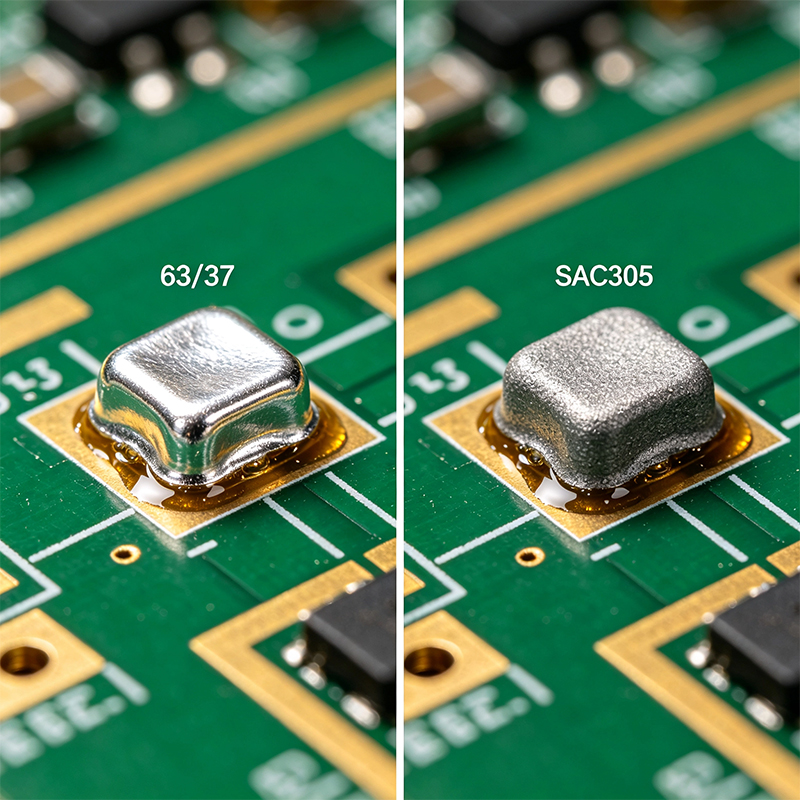
Solder isn't just solder wire. Depending on the assembly process, solder comes in three main forms:
1. Solder Wire
The silver wire on a spool. Used for hand soldering and rework. Solder wire usually has a flux core inside — when soldering, the flux is automatically released to clean the pad and lead surfaces. Very convenient — no need to apply flux separately.
2. Solder Paste
A paste of solder powder mixed with flux — about the consistency of toothpaste. Used for surface-mount (SMT) reflow soldering. Printed onto PCB pads through a stencil, then components are placed and the board goes through a reflow oven.
3. Solder Bar
A solid block of solder, usually rectangular or trapezoidal. Used for wave soldering and selective soldering — melted to form a solder wave that through-hole component leads pass through.
Solder doesn't stick by itself — it needs flux to help. Flux does three things:
Removes oxides: Metal surfaces always have oxide layers. Flux removes them so solder can contact clean metal.
Prevents re-oxidation: During soldering, flux forms a protective layer that keeps oxygen away from molten solder.
Reduces surface tension: Helps molten solder spread and "wet" the surface.
The most common flux is rosin-based flux — natural rosin dissolved in alcohol.
In electronics manufacturing, solder use and quality are governed by IPC J-STD-001. It specifies which solder alloys can be used, how the soldering process should be controlled, and what acceptable solder joints look like.
Approved solder alloys include: Sn60Pb40, Sn62Pb36Ag2, Sn63Pb37 (leaded), and Sn96.3Ag3.7 (lead-free), among others.
Solder is a low-melting-point alloy used to join metal parts. Leaded solder (63/37) melts at 183°C, solders beautifully, but contains lead. Lead-free solder (SAC305) melts at 217-221°C, is RoHS-compliant, but is harder to work with. Solder comes in wire, paste, and bar forms — for hand soldering, SMT reflow, and wave soldering respectively. Flux is solder's "perfect partner" — it removes oxides and helps wetting.

Kaboer manufacturing PCBs since 2009. Professional technology and high-precision Printed Circuit Boards involved in Medical, IOT, UAV, Aviation, Automotive, Aerospace, Industrial Control, Artificial Intelligence, Consumer Electronics etc..


 English



 Wechat
 +86 13670210335
 +86 13670210335
 E-mail