
Date: 2026-07-30
You‘ve definitely seen a paper business card before — a small piece of card stock with a name, a phone number, and a company logo. But have you ever seen a business card made out of a circuit board?
Not a paper card with a circuit pattern printed on it. A real printed circuit board. With copper traces, solder mask, silkscreen text — and sometimes even LEDs that light up, NFC tags that your phone can read, or USB connectors that turn it into a mini computer.
That‘s a PCB business card.
In this guide, I’ll explain what a PCB business card is, why people make them, how they‘re made, and some of the coolest examples out there. Plain English, no fluff.
A PCB business card is exactly what it sounds like — a printed circuit board (PCB) shaped and sized like a business card [9†L13-L14].
A paper business card is made of paper with ink on it. A PCB business card is made of fiberglass, copper foil, and solder mask — it‘s a real circuit board. It’s got copper traces, pads, vias, and silkscreen text. It‘s not just a picture of a circuit — it is a circuit.
The standard card size is roughly 85.6mm × 54mm — the same as a credit card, so it fits right into a wallet slot [8†L37-L38][6†L25]. Thickness usually ranges from 0.6mm to 1.6mm, giving it a substantial, premium feel compared to paper [7†L17][5†L11-L14].
A PCB business card isn‘t just a “business card” — it’s a functional circuit board. You can solder components onto it, power it up, and run programs on it.
You might ask: paper cards are cheap and easy — why go through the trouble of making a circuit board card?
First, it‘s unforgettable.
Hand someone a paper card, and it goes straight into their pocket. Hand them a PCB card with a glowing LED, and they’ll at least stop for a second and ask, “Did you make this yourself?” — the conversation is already started.
Second, it showcases your skills.
For electronics engineers, hardware developers, and makers, a PCB business card is a portable portfolio [10†L4-L5]. The more polished your design and the more clever its functionality, the better it demonstrates your technical abilities. Hand one to an interviewer, and it speaks louder than any resume bullet point about “PCB design experience.”
Third, it‘s a functional tool.
Many PCB business cards aren’t just cards — they‘re rulers, reference tools, NFC tags, or even mini computers [9†L17-L20]. When you hand one over, the recipient gets something useful, not just a piece of paper that’ll end up in the trash.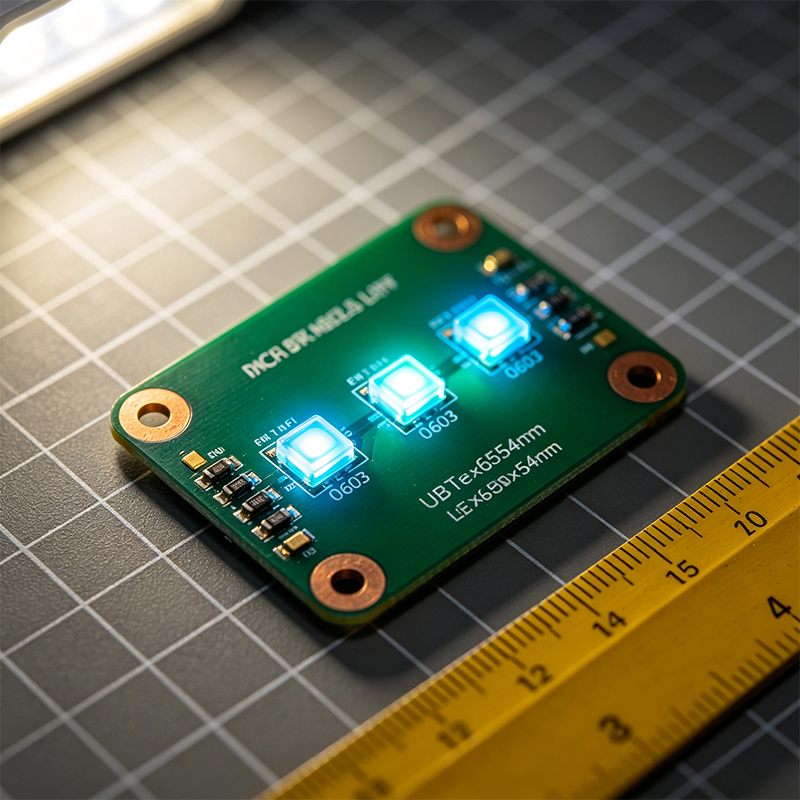
PCB business cards come in three main styles [9†L15-L20]:
Type 1: Visual / Artistic
These focus on aesthetics. They use exposed copper, colored solder mask, and silkscreen to create beautiful patterns and text [9†L16]. The copper traces themselves are the decoration — no components, just pure PCB art [10†L26-L27].
Type 2: Functional / Tool
These cards have useful reference information printed on them — resistor color code charts, component footprint references, trace width tables, millimeter rulers [9†L17-L18]. Hand one to a fellow engineer, and they get a pocket-sized reference tool [1†L37-L39].
Type 3: Interactive / Electronic
This is the most hardcore category. These cards have NFC chips, LEDs, microcontrollers, USB connectors, and other components soldered on [9†L19-L20]. Tap it with a phone and it opens your portfolio [9†L25-L27]. Plug it into a computer and it types out your contact info automatically [0†L45-L46]. Some even run neural networks for voice recognition [10†L8-L16].
The process is essentially the same as making any other PCB:
Step 1: Design
Use EDA software (KiCad [6†L7], EasyEDA [8†L33], Altium Designer [2†L11]) to design the board layout. A simple card can be a two-layer board [8†L25]; complex ones may need more layers.
The main layers you work with are [8†L26-L31]:
Top/Bottom copper: Traces, patterns, and text
Silkscreen: White text and logos
Solder mask: The green (or other color) protective coating
Silkscreen gives you white text and logos [0†L8-L9], copper gives you gold or silver traces and patterns [6†L15-L16], and solder mask determines the board’s base color [2†L9].
Step 2: Generate Gerber files
Export Gerber files — the only format PCB factories can read [0†L9-L10][6†L27].
Step 3: Order from a PCB fab
Send the Gerber files to a PCB prototyping service [6†L27-L28]. There are very cheap options available [2†L20]. 10 cards cost roughly **$24 including shipping** (about $2.40 per card) [6†L31].
Step 4: Solder components (optional)
If you want NFC, LEDs, or other functions, you’ll need to hand-solder the components onto the board [7†L38-L41].
PCB business cards cost more than paper cards, but compared to the impact they make, it’s pocket change:
Bare board (no components) : 5-10 cards cost roughly $10-30 total, or a few dollars per card
With NFC: Add a few dollars for the NFC chip plus soldering time
With a microcontroller: More components, higher cost, but much more functionality [2†L20-L21]
NFC Card: Tap it with a phone and it opens your website or downloads your contact info [9†L25-L27][12†L4-L7]. Common chips include NXP‘s NT3H1101 or NT3H1201 [9†L38].
USB Card: Plug it into a computer and it automatically “types” out your contact info like a human typist [0†L45-L46].
Game Card: Includes a small screen and buttons — you can play Pong on it [11†L25]. Hand one to an interviewer and they’ll never forget you.
Voice Recognition Card: Recognizes spoken digits from “one” to “nine” and displays the result on an LED display [10†L8-L16].
Keyboard Card: It‘s literally a working 40% keyboard. Plug it in and type on it [11†L8-L9][13†L26].
A PCB business card is a business card made from a real printed circuit board. Not paper with a circuit pattern printed on it — real copper, real solder mask, real silkscreen, real components, real electricity.
It costs more than paper. It’s heavier than paper. It‘s harder to make than paper. But it’s unique, it showcases your skills, and it makes people remember you. For electronics engineers, hardware developers, and makers, a PCB business card isn‘t just a card — it’s a portable portfolio, a conversation starter, and a functional tool all in one.

Kaboer manufacturing PCBs since 2009. Professional technology and high-precision Printed Circuit Boards involved in Medical, IOT, UAV, Aviation, Automotive, Aerospace, Industrial Control, Artificial Intelligence, Consumer Electronics etc..


 English



 Wechat
 +86 13670210335
 +86 13670210335
 E-mail