
Date: 2026-06-22
You've definitely seen them. Circuit boards with shiny gold pads. They look more premium than the silver-gray ones, feel smoother to the touch. A lot of people see gold and think "expensive" — and they're not wrong. But that gold isn't just for looks. There's a whole chemical process behind it.
That gold coating is called ENIG — Electroless Nickel Immersion Gold. In Chinese, it's often called "chemical nickel gold" or "immersion gold".
It's one of the most popular high-end surface finishes in the PCB industry today. In this guide, I'll explain what ENIG is, how it's made, its pros and cons, and how it compares to other finishes. Plain English, no fluff.
Let's start with the basics.
The pads and traces on a PCB are made of copper. Copper has a problem — leave it exposed to air for a few days, and it oxidizes. A thin, non-conductive oxide layer forms on the surface. Try to solder onto oxidized copper, and the solder either won't stick or will form a cold joint.
So you need a protective layer over the copper. This layer has to do two things: prevent oxidation and allow solder to wet and spread properly during assembly. That protective layer is called a "surface finish." ENIG is one of them — and it's one of the most widely used high-end options in the industry.
ENIG stands for Electroless Nickel Immersion Gold.
It's actually two metal layers deposited on the copper surface:
Bottom layer: Electroless Nickel — about 3-6 micrometers thick. The nickel acts as a barrier layer — it prevents copper and gold from diffusing into each other. Without this nickel layer, gold would react directly with copper, making solder joints brittle and weak.
Top layer: Immersion Gold — extremely thin, about 0.05-0.1 micrometers. The gold protects the nickel from oxidation and provides excellent solderability.
That gold you see is only a few hundredths of a micrometer thick — hundreds of times thinner than a human hair.
The biggest difference between ENIG and traditional electroplating: it doesn't need electricity. It relies entirely on chemical reactions to deposit the metal layers. This means it can uniformly cover pads and vias of any shape, including the tiniest ones in the deepest corners.
The ENIG process goes through these steps:
Step 1: Pretreatment (Cleaning and Micro-etching)
The board is cleaned to remove oils and oxides. Then a micro-etch solution slightly roughens the copper surface — this helps the nickel layer grip better.
Step 2: Activation (Palladium Catalysis)
The board is dipped into a palladium-containing activation solution. Palladium deposits on the copper surface and acts as a catalyst for the electroless nickel plating. Without this step, the nickel won't plate.
Step 3: Electroless Nickel Plating
The board is dipped into an electroless nickel solution. Nickel ions in the solution are reduced to metallic nickel by a reducing agent and deposit onto the copper surface. This nickel layer is actually a nickel-phosphorus alloy, with phosphorus content typically 6-11%. Thickness is controlled at 3-6 micrometers.
Step 4: Immersion Gold Plating
After nickel plating, the board is dipped into a gold-ion solution. Gold ions undergo a displacement reaction with nickel — gold deposits on the nickel surface while a tiny amount of nickel dissolves. This step is critical. The gold layer must be controlled to about 0.05-0.1 micrometers. Too thin, and it won't protect the nickel. Too thick, and you get "gold embrittlement" — brittle solder joints.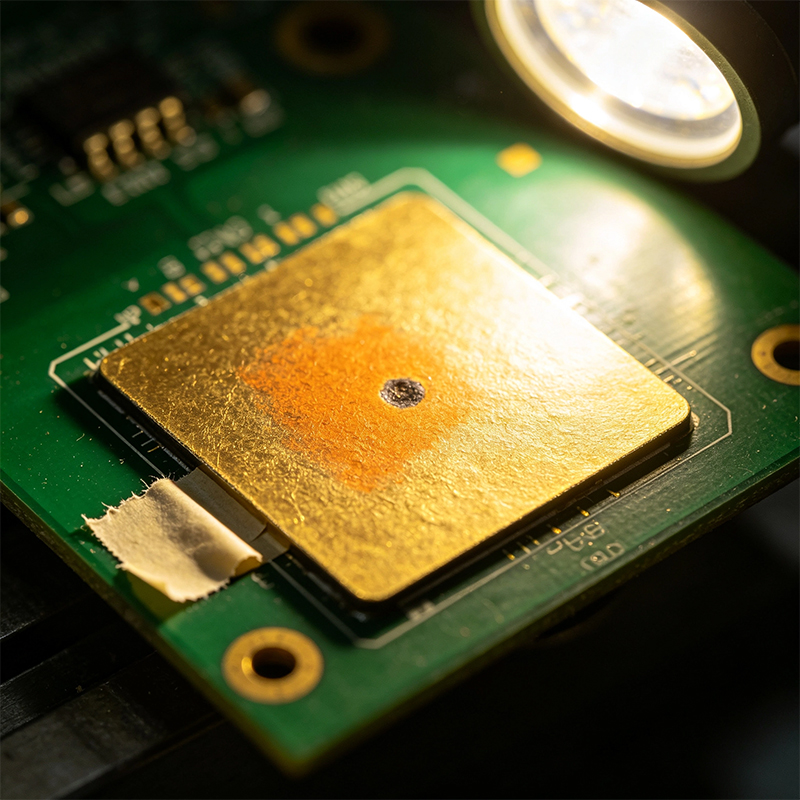
Step 5: Cleaning and Drying
Finally, the board is cleaned, dried, and you get that shiny gold ENIG finish.
1. Extremely flat surface
This is one of ENIG's biggest strengths. HASL (Hot Air Solder Leveling) surfaces are uneven — thickness variation can be up to 25 micrometers. ENIG's surface flatness can be below 0.05 micrometers — almost mirror-smooth. For fine-pitch components (like 0.3mm BGAs, 01005 resistors), this flatness is non-negotiable. Uneven pads cause bridging and cold joints. ENIG eliminates that problem entirely.
2. Excellent solderability
Gold doesn't oxidize, so ENIG pads have a very long shelf life. They stay solderable for over a year. And ENIG survives multiple reflow cycles — if your board needs to go through two or even three reflows, ENIG remains stable.
3. Corrosion-resistant and fingerprint-proof
Ordinary OSP boards can be ruined by a single touch. ENIG's gold layer doesn't care about fingerprints. This is a huge practical advantage on the production line.
4. RoHS-compliant
ENIG is completely lead-free and meets EU environmental standards.
5. Great for keypad contacts
If your board has keypad contacts (like the metal dome contacts under remote control buttons), ENIG is a great choice — gold is conductive, wear-resistant, and doesn't oxidize.
1. Expensive
ENIG costs significantly more than HASL. The reasons are simple — you're using nickel and gold, and the process has more steps with tighter controls. For cost-sensitive, high-volume products, ENIG might not be the best choice.
2. "Black Pad" defect
This is ENIG's most notorious issue. "Black Pad" occurs when the nickel layer is over-corroded during the immersion gold process, leaving a rough, porous, dark surface. Pads with Black Pad have terrible solderability — the joint looks soldered but is extremely weak and will crack under stress. And here's the kicker — you can't see it with the naked eye. The pad still looks shiny gold on the surface. You can only confirm it with SEM (scanning electron microscopy). In 2002, IPC released IPC-4552 specifically to standardize ENIG process control and reduce Black Pad occurrences.
3. Difficult to rework
Once an ENIG finish is damaged, it's very hard to repair locally. If a pad fails, the entire board might be scrap.
4. Higher signal loss at high frequencies
ENIG has slightly higher signal loss at very high frequencies compared to finishes like Immersion Silver. For extreme high-frequency applications (5G mmWave, radar), you need to evaluate carefully.
ENIG is best for:
Fine-pitch BGAs, QFNs, QFPs — need ultra-flat surfaces
High-density interconnect (HDI) boards — fine lines and small vias need flatness
High-end consumer electronics (phones, tablets, laptops)
Medical devices, aerospace, military — where reliability is critical
Keypad contacts and gold fingers — need wear-resistant conductive surfaces
Boards that need long storage — ENIG lasts over a year
Avoid ENIG for:
Cost-sensitive high-volume low-end products — HASL or OSP are cheaper
Extreme high-frequency applications (>10GHz) — consider Immersion Silver or ENEPIG
| Finish | Cost | Flatness | Shelf Life | Best For |
|---|---|---|---|---|
| ENIG | High | Excellent | Long (>1 year) | BGA, fine-pitch, high-reliability |
| HASL | Low | OK | Medium (6 months) | Through-hole, cost-sensitive |
| OSP | Very Low | Good | Short (months) | Single-use consumer electronics |
| Immersion Silver | Medium | Good | Medium (6-12 months) | High-frequency, telecom |
One-sentence summary: If your board has fine-pitch BGAs or demands high reliability — ENIG is money well spent. If you just need a basic board that works, HASL or OSP are more economical.
ENIG (Electroless Nickel Immersion Gold) is a surface finish that deposits a layer of nickel (3-6µm) and a layer of gold (0.05-0.1µm) onto copper pads using chemical reactions.
It's flat, solderable, long-lasting, and corrosion-resistant — the go-to choice for BGAs and high-density boards. But it's expensive, and there's a Black Pad risk. Whether you choose ENIG depends on whether your product needs "ultimate reliability" or just "good enough."

Kaboer manufacturing PCBs since 2009. Professional technology and high-precision Printed Circuit Boards involved in Medical, IOT, UAV, Aviation, Automotive, Aerospace, Industrial Control, Artificial Intelligence, Consumer Electronics etc..


 English


 Wechat
 +86 13670210335
 +86 13670210335
 E-mail