
Date: 2026-07-30
You've definitely seen them before. Those cylindrical components standing upright on a circuit board like little buckets, with a metal vent pattern pressed into the top and capacitance and voltage printed on the side. That's an electrolytic capacitor.
Electrolytic capacitors are among the most common and important components in electronics — power supplies, amplifiers, chargers, motor drives — anywhere "smooth power" is needed, they're there. In this guide, I'll explain what an electrolytic capacitor is, how it works, what types exist, and where it's used. Plain English, no fluff.
An electrolytic capacitor is a capacitor that uses an electrolyte (conductive liquid) as its cathode. Unlike regular capacitors, electrolytic capacitors provide very large capacitance — for the same volume, an electrolytic can be tens or even hundreds of times more capacitative than a standard capacitor.
Inside, it's like a sandwich:
Anode: An aluminum foil with an extremely thin aluminum oxide insulating layer
Cathode: A conductive liquid (the electrolyte) — not a solid metal
Dielectric: The oxide layer between them
Why so much capacitance? The key is the oxide layer is incredibly thin — thousands of times thinner than a human hair. The closer the plates, the higher the capacitance.
Think of it like this: an electrolytic capacitor is a bucket, and a regular capacitor is a frying pan. A frying pan only holds a thin layer of water (charge). A bucket holds a lot. How much "water" the bucket can hold is its capacitance, measured in farads (F) .
Electrolytic capacitors have one critical rule: they have positive and negative terminals. Most electrolytic capacitors are polarized — positive must connect to higher voltage, negative to lower voltage. Reverse the polarity, and you risk leakage, overheating, or even explosion.
Why? The oxide insulating layer is "grown" on the anode. If the voltage is reversed, the oxide layer breaks down, current flows directly through, and gas builds up quickly — the case bulges and bursts.
That's why electrolytic capacitors have vent patterns on top — not decoration, but a deliberate weak point. If gas builds up, it cracks open there instead of exploding the entire board.
The exception: non-polarized electrolytic capacitors (NP type) . These are essentially two polarized capacitors connected "back-to-back," allowing bidirectional voltage. Used in AC signal circuits like audio coupling.
Every electrolytic capacitor has two numbers that matter most: capacitance and voltage rating.
Capacitance: Measured in farads (F), typically in microfarads (μF) and picofarads (pF). 1μF = 0.000001F. Electrolytic capacitors range from a few microfarads to thousands or even farads. The larger the capacitance, the more charge it can store and the better it smooths voltage.
Voltage rating: Measured in volts (V) — 6.3V, 16V, 25V, 50V, 100V, 400V, etc. This is the maximum voltage the capacitor can handle. Always choose a voltage rating higher than the actual circuit voltage — typically 20-50% headroom.
For example, if your circuit runs at 12V, select at least 16V, with 25V being safer. Too low, and the capacitor breaks down, leaks, or bursts. Too high, and it's bigger and more expensive — but safer.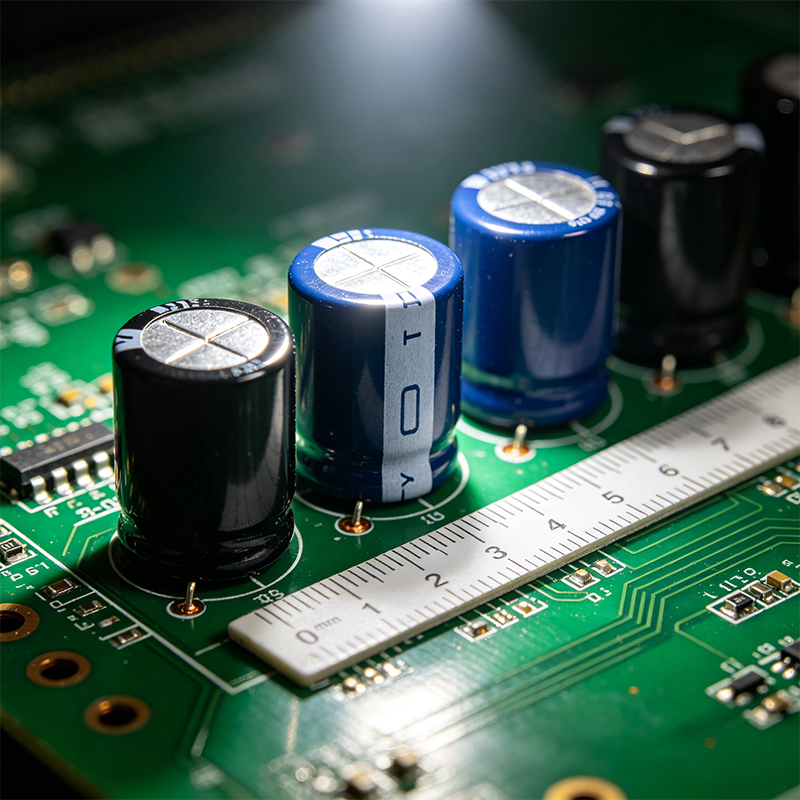
Electrolytic capacitors are everywhere:
1. Power Supply Filtering
This is the classic use. After rectification, AC becomes "pulsating DC" — a bumpy, uneven voltage. An electrolytic capacitor acts like a bucket — charging when voltage is high and releasing when it drops, smoothing the "waves" into stable DC.
2. Audio Amplifier Coupling
Audio signals are AC. Different circuit stages need to pass the signal without passing DC bias voltage. An electrolytic capacitor blocks DC while passing AC, isolating the two stages.
3. Motor Starting and Running
Fans, compressors, and air conditioners need capacitors to start and run motors. These are usually AC electrolytic capacitors — large capacitance, high voltage, and built for frequent start-stop cycles.
4. Flash and Pulse Circuits
Camera flash units use a large electrolytic capacitor charged to hundreds of volts, slowly charged and discharged instantly to produce a bright flash.
Electrolytic capacitors are among the few electronic components with a limited lifespan. Life depends on two factors: temperature and operating voltage.
Temperature is the biggest enemy. For every 10°C increase, electrolytic capacitor life halves. A 105°C-rated capacitor at 85°C lasts a long time; at 125°C, it might fail in months.
Long periods without power also degrade them. The oxide layer "relaxes" over time, causing high leakage when voltage is reapplied. That's why old devices sometimes go "pop" when powered on — a capacitor failed.
High frequency and ripple current accelerate aging. More current and faster changes mean more internal heating, faster electrolyte consumption.
Electrolytic capacitors come in two common types:
| Feature | Aluminum Electrolytic | Tantalum Electrolytic |
|---|---|---|
| Anode material | Aluminum foil | Tantalum metal |
| Dielectric | Aluminum oxide | Tantalum oxide |
| Capacitance range | A few μF to 10,000+ μF | 0.1μF to 1000+ μF |
| Size | Large | Small |
| ESR | Relatively high | Low |
| Leakage current | High | Low |
| Voltage range | Typically 6.3V-500V | Typically 6.3V-50V |
| Lifetime | Limited (electrolyte dries) | Long (solid tantalum) |
| Cost | Low | High (tantalum is a precious metal) |
| Main use | Power supply filtering | Signal coupling, filtering |
Aluminum is cheap and high-capacitance — great for power filtering. Tantalum is small, low-ESR, and stable — great for signal processing and high-reliability applications.
The global aluminum electrolytic capacitor market was valued at approximately $4.2 billion in 2025** and is projected to reach **$6.5 billion by 2032. The broader electrolytic capacitor market is estimated at $6.3 billion in 2025**, expected to cross **$10 billion by 2034, growing at a 6.9% CAGR.
EVs, renewable energy, 5G base stations, and AI servers are the fastest-growing segments — all requiring large, high-voltage, long-life electrolytic capacitors.
An electrolytic capacitor is a high-capacitance capacitor that uses an electrolyte as its cathode and an oxide layer as its dielectric.
It's large in capacitance, small in size, and cheap — the go-to choice for power filtering, audio coupling, and motor starting. But it's polarized — reverse it and it explodes. And it has a limited lifespan — heat kills it faster.
Choosing an electrolytic capacitor comes down to two numbers: capacitance and voltage rating. Get those right, use it in the right place, and it will work reliably for years

Kaboer manufacturing PCBs since 2009. Professional technology and high-precision Printed Circuit Boards involved in Medical, IOT, UAV, Aviation, Automotive, Aerospace, Industrial Control, Artificial Intelligence, Consumer Electronics etc..


 English



 Wechat
 +86 13670210335
 +86 13670210335
 E-mail