
Date: 2026-06-22
You get a circuit board and notice the pads have a silver‑gray coating on them. It looks a little uneven, maybe even bumpy. You probably didn't think much about it. But that coating determines how well the board solders, how long it lasts on the shelf, and what kind of products it can go into.
That coating is called HASL — Hot Air Solder Leveling. In Chinese, it's often called "spray tin" or "hot air leveling."
It's the oldest, most classic, and cheapest PCB surface finish out there. In this guide, I'll explain what HASL is, how it's made, its pros and cons, and how it compares to other finishes. Plain English, no fluff.
Let's start with the basics: why do you need to coat a circuit board in the first place?
The answer is simple: copper oxidizes.
The pads and traces on a PCB are made of copper. Leave copper exposed to air for a few days, and a thin layer of oxide forms on the surface. That oxide layer doesn't conduct electricity and doesn't stick to solder. Try to solder components onto an oxidized pad, and you'll either get a cold joint or the solder won't stick at all.
So you need a protective layer over the copper. This layer has to do two things: prevent oxidation and allow solder to wet and spread properly during assembly. That protective layer is called a "surface finish."
HASL stands for Hot Air Solder Leveling.
The process is straightforward: dip the entire PCB into a bath of molten solder, coating all exposed copper pads with solder, then use high‑pressure hot air to blow off the excess, leaving a thin, even layer of solder on the pads.
Think of it as "dipping the board in liquid tin."
Traditional HASL uses a 63% tin / 37% lead alloy, which melts at 183°C. Then the EU introduced the RoHS directive in 2006, banning lead in most consumer electronics. That gave us lead‑free HASL, which replaces lead with alloys like SAC305 (tin‑silver‑copper) or tin‑copper. Lead‑free HASL melts at 217‑227°C — significantly hotter.
The HASL process goes through these steps:
Step 1: Cleaning (Micro‑etching)
The board is cleaned to remove grease, contaminants, and oxidation, exposing fresh copper.
Step 2: Flux application
Flux is applied to the board. Flux reduces surface tension between the solder and copper, helping the solder wet and spread properly.
Step 3: Solder dipping
The board is dipped into a bath of molten solder, coating all exposed copper pads. Dip time is typically only 2‑4 seconds — longer dips create excessive intermetallic compounds.
Step 4: Hot air leveling
The board is pulled out and high‑pressure hot air knives blow off the excess solder. Air knife pressure, angle, and distance all affect the final solder thickness and uniformity.
Step 5: Cooling and cleaning
The board cools down, then is washed with hot water to remove flux residue and solder dust. Cold water would cause warping or water spots.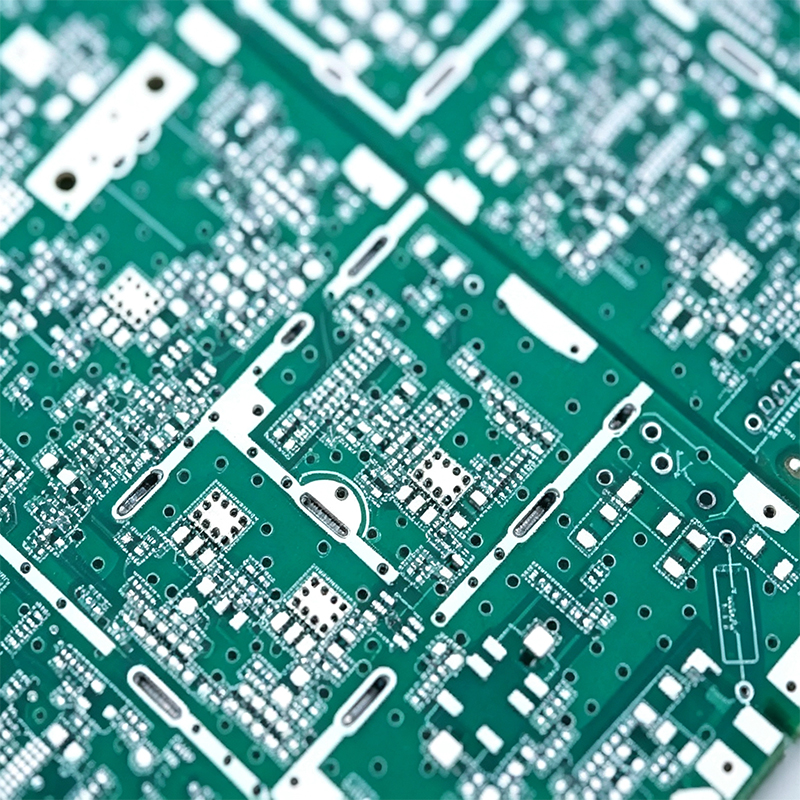
Step 6: Drying and inspection
The board is dried and inspected for rough solder, insufficient or excessive coating.
This is where a lot of people get confused.
Leaded HASL (Traditional)
Uses tin‑lead alloy (Sn63/Pb37). Melting point 183°C. Produces a bright, smooth finish with excellent solderability. But it contains lead, which violates RoHS and can't be exported to Europe.
Lead‑Free HASL (Modern)
Uses SAC305 (tin‑silver‑copper) or tin‑copper alloy. Melting point 217‑227°C. Produces a duller, less flat finish. But it's environmentally friendly and RoHS‑compliant. The downside is higher process temperatures, which stress the board more.
Today, lead‑free HASL is the industry default. Unless your product doesn't need to be exported and you don't care about environmental compliance, you'll be using lead‑free.
1. Cheap
HASL is one of the most economical surface finishes out there. For high‑volume, cost‑sensitive projects, that's a huge advantage.
2. Good solderability
The solder coating itself melts and flows beautifully during assembly. Whether you're hand soldering or using automated SMT, it's very forgiving.
3. Widely available
Almost every PCB manufacturer offers HASL. You don't need to hunt for a specialty shop.
4. Decent shelf life
HASL boards last longer on the shelf than OSP. OSP degrades in months; HASL can sit for a year or more without issues.
5. Great for through‑hole components
If your board has DIP parts, HASL is excellent because the solder coats the inside of the plated holes.
1. Uneven surface
This is HASL's biggest weakness. The hot air doesn't create a perfectly flat surface — some pads are thicker, some thinner. For fine‑pitch components (0.5mm pitch or smaller, like QFNs and BGAs), this unevenness causes bridging and cold joints.
2. Thermal shock
The board gets dipped into 230‑250°C molten solder. That's a lot of heat. Thin boards can warp; multilayer boards can delaminate.
3. Not suitable for high‑frequency
The uneven solder thickness makes impedance control difficult. If your product runs 5G, radar, or high‑speed digital signals, avoid HASL.
4. Lead‑free HASL looks dull
Lead‑free HASL produces a matte, non‑shiny finish. It works fine, but some people don't like the look.
HASL is best for:
Cost‑sensitive, high‑volume products
Boards with mostly through‑hole (DIP) components
Component pitch greater than 0.5mm (QFP, SOP are fine)
Non‑high‑frequency designs
Boards that aren't ultra‑thin or ultra‑dense (less thermal stress risk)
Avoid HASL for:
Fine‑pitch components (0.5mm and below — QFN, BGA)
High‑frequency circuits (5G, radar, high‑speed digital)
Very thin boards (warpage risk)
| Finish | Cost | Flatness | Shelf Life | Best For |
|---|---|---|---|---|
| HASL | Low | Okay | Medium | General‑purpose, through‑hole, cost‑sensitive |
| Lead‑free HASL | Low‑Mid | Slightly worse | Medium | RoHS‑compliant general‑purpose |
| ENIG | High | Excellent | Long | Fine‑pitch, BGA, high‑reliability |
| OSP | Very Low | Good | Short (months) | Single‑use consumer electronics |
One‑sentence summary: If your board doesn't have BGAs, doesn't use ultra‑fine pitch, needs to be cheap, and doesn't run high‑frequency signals — HASL is the best value choice. If you have fine‑pitch BGAs or high‑frequency signals, spend the extra money on ENIG.
HASL (Hot Air Solder Leveling) is the process of dipping a PCB into molten solder and using hot air to blow off the excess, leaving a protective solder coating on the pads.
It's cheap, solderable, mature, and widely available — the workhorse of PCB surface finishes. But it's uneven, thermally stressful, and unsuitable for fine‑pitch or high‑frequency designs. Whether you choose HASL depends on whether your product needs "good enough" or "the best."

Kaboer manufacturing PCBs since 2009. Professional technology and high-precision Printed Circuit Boards involved in Medical, IOT, UAV, Aviation, Automotive, Aerospace, Industrial Control, Artificial Intelligence, Consumer Electronics etc..


 English



 Wechat
 +86 13670210335
 +86 13670210335
 E-mail