
Date: 2026-07-03
You've definitely seen flexible circuit boards before. That thin yellow ribbon connecting your phone's screen to its motherboard. The bendable cable in a foldable phone's hinge. The ultra-thin circuit inside a smartwatch. What makes these boards bend isn't just clever design—it's the materials they're made of.
A rigid board uses fiberglass and epoxy (FR4)—stiff like a wooden plank. A flexible circuit board uses bendable plastic film as its base—like a thick piece of paper. In this guide, I'll explain all the materials that go into a flexible circuit board: the substrate, the copper, the coverlay, and the stiffeners. Plain English, no fluff.
The substrate is the most important part of a flexible circuit board—it's the foundation. It determines how much heat the board can handle, how tight it can bend, and how much stress it can take.
Polyimide (PI) — The Industry Gold Standard
Polyimide is the most widely used substrate material for flexible circuit boards. DuPont has a famous brand called Kapton®.
Why is it the king? Several superpowers:
Heat resistance: Can handle 260°C long-term and 400°C short-term. Decomposition temperature exceeds 500°C. It survives lead-free soldering and works in engine compartments and aerospace.
Excellent flexibility: Can bend hundreds of thousands of times without cracking.
Chemical resistance: Stands up to solvents and corrosion.
Great electrical properties: Dielectric constant below 2.8 (at 10GHz), dissipation factor below 0.003—minimal signal loss at high frequencies.
CTE matches copper: Expands at the same rate as copper when heated, so traces don't peel off the substrate.
The downside: expensive.
Polyester (PET) — The Budget Option
Polyester is polyimide's "cheaper cousin". Its biggest advantage is low cost.
But you get what you pay for:
Low temperature tolerance: About 150°C long-term. Can't handle lead-free reflow soldering.
Limited flexibility: Only good for static bends, not repeated bending.
Moderate chemical resistance.
PET is used in disposable electronics, low-power sensors, LED strips, simple jumpers. When cost is king and bending is minimal, PET works.
Polyethylene Naphthalate (PEN) — The Middle Ground
PEN sits between PET and PI—more heat-resistant than PET, cheaper than PI. Handles about 180°C with better dimensional stability than PET.
If your product needs better thermal performance than PET but doesn't need PI's extreme capabilities, PEN is a solid compromise. Common in display modules, moderate-temperature consumer electronics.
Liquid Crystal Polymer (LCP) — The High-Frequency King
LCP is designed specifically for high-frequency, high-speed signals. Its dielectric constant is extremely low, with minimal signal loss—perfect for 5G mmWave antennas, radar, high-speed communications.
LCP can survive over 1 million bend cycles. In 2025, Murata released an ultra-low-loss LCP substrate with a dielectric constant below 2.0, designed for 6G. LCP is also the most expensive—several times the cost of PI.
PTFE (Teflon) — The Extreme High-Frequency Choice
PTFE has the best dielectric properties of any material—the lowest signal loss. It's also the most expensive and extremely difficult to process. Used in research, aerospace, medical implants.
With a foundation in place, you need "veins"—copper foil is the conductive traces on a flexible board.
There are two main types:
Rolled Annealed (RA) Copper
RA copper is made by repeatedly rolling a copper ingot—the grain structure is elongated and fibrous. This makes it highly bend-resistant—it doesn't crack under repeated bending. For dynamic, repeated bending (foldable phone cables, printer heads), RA copper is a must.
The downside: expensive.
Electrodeposited (ED) Copper
ED copper is deposited through electroplating—the grain structure is columnar and brittle. Its flexibility is only about one-third of RA copper. Only suitable for static bends or barely any bending.
The upside: cheap.
The rule: repeated bending → RA copper; bend once or never → ED copper.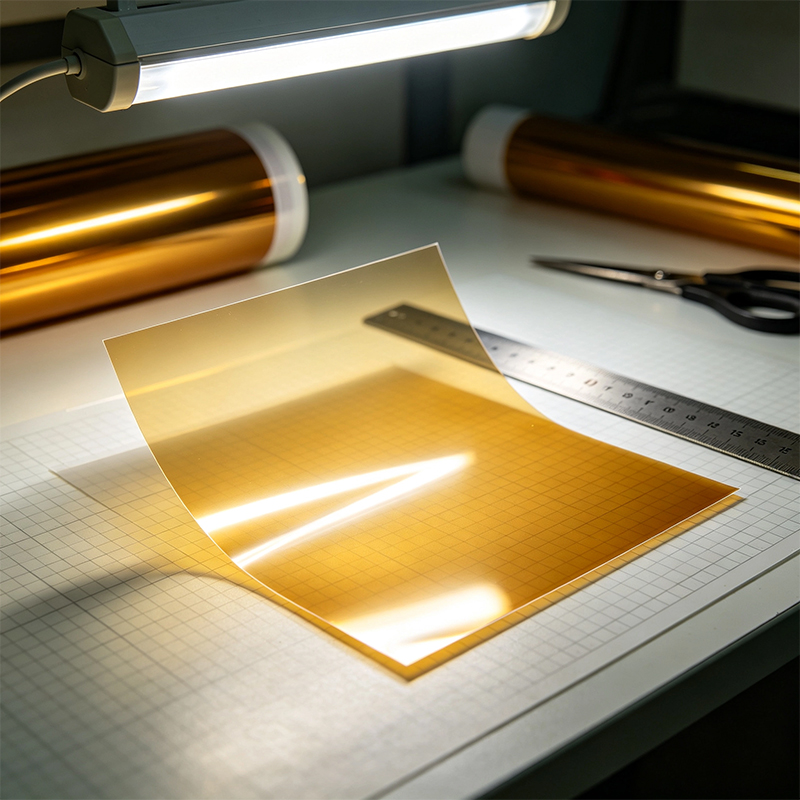
Flexible boards don't use the green solder mask that rigid boards use. Instead, they use a coverlay to protect the copper traces.
Coverlay is usually made of polyimide (PI). It does the same job as solder mask—prevents oxidation, protects against scratches, resists chemicals. The difference: coverlay is laminated on, not painted on. A flexible board bends repeatedly; painted solder mask would crack, but laminated film survives.
For cost-sensitive applications, PET coverlay is sometimes used instead of PI—but PET doesn't match PI's heat resistance or flexibility.
There's also photoimageable coverlay, which can be exposed and developed like solder mask for higher precision openings.
Flexibility is great—but some areas shouldn't bend. Connector mounting points, screw holes, and areas that get plugged and unplugged need to be rigid.
So you add a stiffener—a rigid piece laminated to the back of the flex board in specific areas.
Common stiffener materials:
FR4: Most common and cheapest—same material as rigid boards
Polyimide (PI): CTE matches the flex board better, thinner
Stainless steel: Stiffest, for extreme strength requirements
Aluminum: Adds rigidity and helps with heat dissipation
Stiffener thickness ranges from 0.05mm to 1.6mm.
| Material | Temp Resistance | Flexibility | Cost | Best For |
|---|---|---|---|---|
| PI (Polyimide) | 260-400°C | Excellent | High | Most flex boards, wearables, medical, automotive |
| PET (Polyester) | ~150°C | Moderate | Low | LED strips, disposable electronics, cost-sensitive |
| PEN | ~180°C | Good | Medium | Display modules, moderate-temp applications |
| LCP | High | Excellent | Very High | 5G antennas, mmWave radar, high-frequency |
| PTFE | Very High | Moderate | Very High | Extreme high-frequency, aerospace |
| RA copper | — | Bend-resistant | High | Dynamic, repeated bending |
| ED copper | — | Moderate | Low | Static bends, minimal bending |
Flexible circuit board materials aren't chosen randomly. The substrate determines heat and flexibility, the copper determines bend life, the coverlay protects the traces, and stiffeners keep the hard parts hard.
Most flex boards: PI substrate + RA copper + PI coverlay—the industry standard.
Cost-sensitive, minimal bending: PET substrate + ED copper + PET coverlay.
5G, radar, high-frequency: LCP or PTFE substrate.
Under connectors, screw holes: Add FR4 or PI stiffener.

Kaboer manufacturing PCBs since 2009. Professional technology and high-precision Printed Circuit Boards involved in Medical, IOT, UAV, Aviation, Automotive, Aerospace, Industrial Control, Artificial Intelligence, Consumer Electronics etc..


 English



 Wechat
 +86 13670210335
 +86 13670210335
 E-mail