
Date: 2026-03-13
Let's be honest. When you're looking for a PCB or PCBA partner, the first thing you worry about is quality. Will the boards work? Will they be consistent? Will you get the same quality on the tenth batch as you did on the first?
I've seen too many manufacturers learn the hard way that not all PCB suppliers are created equal. Some cut corners. Some have no real quality systems. Some promise the world and deliver boards that fail in the field.
That's why company ISO 9001 certified isn't just a badge on a website. It's your first real clue that a manufacturer takes quality seriously.
Let's talk about what ISO 9001 actually means for PCB and PCBA manufacturing, why it matters for your products, and how to find a partner who lives up to the standard—not just one who bought the certificate.
ISO 9001 is the international standard for quality management systems (QMS) . It's not about a specific product or service—it's about how a company runs its processes to consistently deliver what customers expect.
When a PCB/PCBA company is ISO 9001 certified, it means:
They have documented processes for everything that affects quality—from incoming material inspection to final testing
They monitor and measure their processes to ensure they're working as intended
They have systems to catch and correct problems when they occur
They're committed to continuous improvement, not just maintaining the status quo
They're audited regularly—by both internal teams and external certification bodies—to prove they're following their own rules
The certification isn't permanent. Companies must be re-certified periodically, with surveillance audits to ensure they're still complying . This ongoing oversight is what makes ISO 9001 meaningful.
In the electronics industry, quality isn't optional. A single bad board can delay a production run, cost thousands in rework, or worse—fail in the field, damaging your reputation.
Here's how an ISO 9001 certified company protects you:
ISO 9001 requires documented procedures for every critical step . That means from the moment your Gerber files arrive to the moment boards ship, there's a defined way of doing things. No guessing. No "making it up as we go."
For PCB fabrication, this means:
Controlled etching parameters so trace widths are consistent
Documented lamination cycles to prevent delamination
Verified plating thickness in every batch
Standardized inspection criteria so every board is judged the same way
For PCBA assembly, this means:
Controlled solder paste printing parameters
Calibrated pick-and-place machines
Documented reflow profiles
Consistent inspection and testing procedures
When processes are controlled, results are predictable. You get the same quality, batch after batch.
ISO 9001 requires traceability . If something goes wrong, you can trace it back to the root cause. Which batch of material? Which operator? Which machine? Which process step?
This isn't about blaming—it's about fixing. With traceability, problems don't just get patched; they get solved at the source.
ISO 9001 emphasizes monitoring and measurement . Certified companies don't just wait for boards to fail—they actively look for problems before they leave the factory.
Incoming inspection catches bad materials before they're used
In-process checks catch issues before they compound
Final testing verifies every board before shipment
This proactive approach means fewer surprises for you.
ISO 9001 requires companies to continuously improve their processes . It's not about being perfect—it's about getting better.
Certified companies collect data, analyze it, and make changes to reduce defects, improve efficiency, and increase customer satisfaction. Over time, this means you get better quality, faster turnaround, and fewer headaches.
When you work with an ISO 9001 certified company, you're not just trusting their word—you're trusting a system that's been audited by an independent third party . That's a level of confidence you don't get with uncertified suppliers.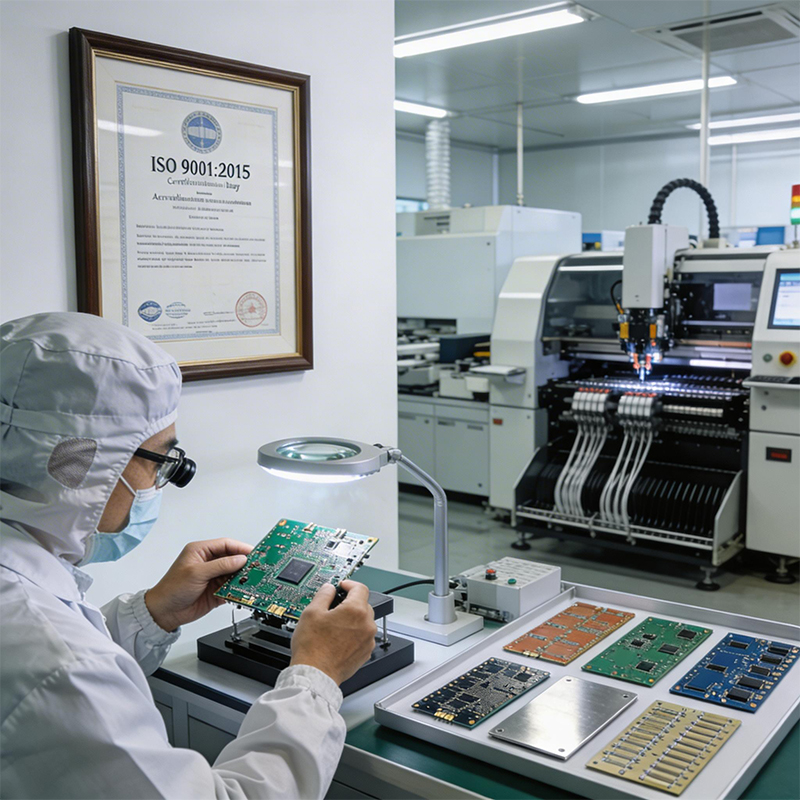
Let's get specific about how ISO 9001 affects the boards you receive.
Certified companies have documented processes for selecting, inspecting, and storing materials. Laminates, copper foils, solder masks, components—they all get checked. If a material doesn't meet specifications, it doesn't go into production.
Every step of PCB fabrication and assembly has defined parameters:
Etching: controlled temperature, pressure, and chemistry
Lamination: documented temperature and pressure profiles
Drilling: verified tool sizes, speeds, and registration
Plating: monitored thickness and uniformity
Solder paste printing: controlled pressure, speed, and alignment
Reflow: validated temperature profiles for each board type
These parameters aren't just set once—they're monitored continuously. If something drifts out of spec, the process stops until it's fixed.
ISO 9001 requires documented inspection and testing procedures. For PCB/PCBA, that means:
Automated Optical Inspection (AOI) on critical layers
X-ray inspection for hidden joints (BGAs, QFNs)
Electrical testing for shorts and opens
Impedance testing for high-speed designs
Microsection analysis for plating quality
And all these inspections are documented. If you need proof, certified companies can provide it.
When problems do occur (and they will, in any manufacturing process), ISO 9001 requires a formal corrective action process . This isn't about quick fixes—it's about finding the root cause and preventing recurrence.
For you, that means if something goes wrong with your order, you get a real solution, not just a "we'll be more careful next time."
Anyone can put an ISO 9001 logo on their website. Verifying it takes a few extra minutes—and it's worth it.
Step 1: Ask for the certificate. A legitimate certified company will share their certificate freely. It should include the company name, scope of certification, standard (ISO 9001:2015), certification body, issue and expiration dates.
Step 2: Check the certification body. Is it a recognized, accredited registrar? Major ones include DNV, SGS, BSI, TÜV, UL, and others. If the certificate is from an unknown body, be suspicious.
Step 3: Verify with the registrar. Most certification bodies have online databases where you can verify active certificates. Look up the company name and confirm the certification is current.
Step 4: Read the scope. The certificate should specify what activities are covered—"PCB fabrication," "PCBA assembly," "design services," etc. Make sure your needs are within the certified scope.
Step 5: Ask questions during your audit. If you visit the factory, look for evidence of ISO 9001 in action. Documented procedures, training records, calibration logs, inspection records—these are signs that the system is real, not just a paper exercise.
ISO 9001 is foundational, but depending on your industry, you may need more.
IATF 16949 – Automotive-specific quality management, with additional requirements for defect prevention and supply chain management
ISO 13485 – Medical devices, with stricter requirements for risk management and traceability
AS9100 – Aerospace, with additional requirements for safety and reliability
ISO 14001 – Environmental management, showing commitment to sustainable practices
UL certification – Product safety certification for specific materials and processes
A truly quality-focused manufacturer will have relevant certifications for your industry.
At Kaboer, we've been ISO 9001 certified since our early days. It's not a badge we bought—it's a system we live by.
From the moment you send your requirements, ISO 9001 principles guide everything we do:
1. Design and Review
Your Gerber files and BOM go through a documented review process. Our engineers check for manufacturability, potential issues, and compliance with your specifications. This DFM review is part of our quality system—not an afterthought.
2. Material Control
We source materials from approved suppliers and inspect them on arrival. Every batch of laminate, every reel of components, every bottle of solder mask is verified before it enters production. Non-conforming materials are identified and quarantined.
3. Process Control
Our fabrication and assembly processes are documented and monitored. Operators follow standard work instructions. Equipment is calibrated on schedule. Parameters are logged and reviewed. If something drifts, we catch it early.
4. In-Process Inspection
We don't wait until the end to check quality. AOI on inner layers, solder paste inspection (SPI), X-ray for hidden joints—these checks happen throughout production, catching issues before they compound.
5. Final Testing
Every board gets tested. Electrical test for shorts and opens. Impedance test when required. Functional test for assembled boards. Test results are documented and traceable.
6. Corrective Action
If problems occur, we have a formal process to find the root cause and prevent recurrence. You don't get excuses—you get solutions.
7. Continuous Improvement
We track key metrics—defect rates, on-time delivery, customer feedback—and use them to improve. ISO 9001 isn't about standing still; it's about getting better.
We apply these quality standards across our full range:
Flexible PCBs (FPC) : 1-20 layers, 0.075mm to 0.4mm thick
Rigid-Flex Boards: 2-30 layers
Rigid PCBs: 1-30 layers, FR-4 to high-performance materials
HDI High-Density Boards: Microvias, fine lines down to 2mil
High-Frequency Boards: Rogers, PTFE, other low-loss materials
Full PCBA with SMT and through-hole assembly
Need prototypes quickly? Our fast prototyping service delivers boards in days, not weeks—while still following ISO 9001 processes. You get speed without sacrificing quality.
We're in Shenzhen, and we welcome overseas customers to visit our factory. See our ISO 9001 quality system in action. Walk the floor, meet the team, ask whatever you want. Our certification isn't a secret—it's something we're proud to show.
When you choose a PCB/PCBA manufacturer, you're not just buying boards—you're buying confidence. Confidence that your products will work, that your timeline will be met, that your reputation is safe.
An ISO 9001 certified company gives you that confidence.
If you need a reliable ISO 9001 certified PCB/PCBA company with custom capabilities and fast prototyping, send us your requirements. We'll provide a free quote, verify our ISO 9001 certification for you, and welcome you to visit our factory in Shenzhen to see our ISO 9001 compliant production process in person.
Because when quality is built into every step, you get products you can trust.

Kaboer manufacturing PCBs since 2009. Professional technology and high-precision Printed Circuit Boards involved in Medical, IOT, UAV, Aviation, Automotive, Aerospace, Industrial Control, Artificial Intelligence, Consumer Electronics etc..


 English


 Wechat
 +86 13670210335
 +86 13670210335
 E-mail